
Power Connector Selection Guide
Battery Terminal Connector Types for Reliable Power Projects
Battery terminal connector types look simple from the outside, but they shape how reliably current moves from the battery pack into the cable, charger, controller, or power distribution module. For engineers and sourcing teams, the right choice is not only a matter of terminal shape. It depends on contact stability, cable routing, environmental exposure, service access, and the documentation your project needs before production approval.
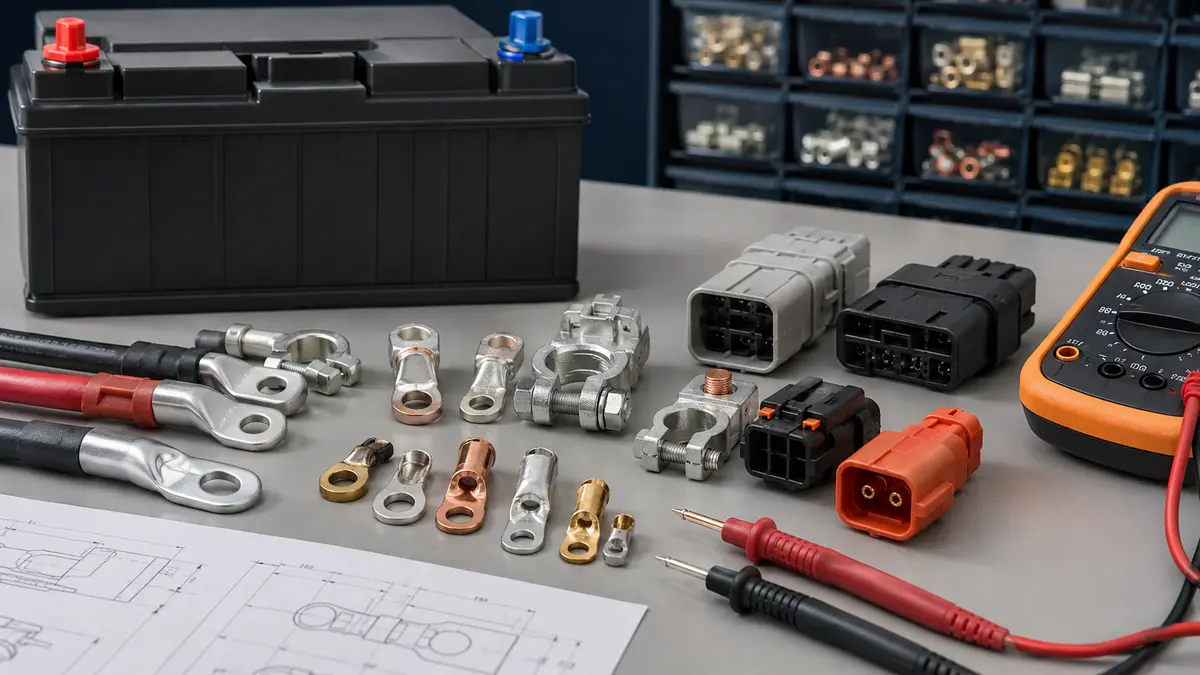
This guide explains common battery connector types, how battery charger connector types differ from pack-side terminals, what changes for lithium battery connector types, and how service teams should approach connector replacement without turning a maintenance job into a recurring field issue.
Engineering note: Any voltage, current, temperature rise, creepage, plating, mating-cycle, flammability, or environmental rating must be confirmed against the selected connector drawing, datasheet, test report, and application conditions. This article is a selection framework, not a substitute for project validation.
Why Battery Connector Failures Usually Start Small
Most battery connector failures begin as minor mechanical or surface changes. Moisture reaches an exposed interface. A cable is routed with too much unsupported weight. A crimp barrel does not fully grip the conductor. A terminal surface gradually oxidizes. Each issue may look harmless during assembly, but the combined result is higher contact resistance, heat, intermittent power delivery, and difficult troubleshooting in the field.
In industrial equipment, material handling systems, backup power units, portable devices, and vehicle power modules, the terminal-to-cable interface often sees vibration, cleaning chemicals, dust, humidity, and repeated service activity. A connector that works on a clean bench may become unstable when the cable bend radius, enclosure seal, clamp force, or terminal plating is not matched to the real environment.
This is why battery terminal connector types should be reviewed as part of the full power path. The connector is not an isolated part number. It interacts with the battery post or pack terminal, cable lug, insulation support, housing, latch, seal, charger interface, and the maintenance procedure used by the service team.
Common Battery Terminal Connector Types
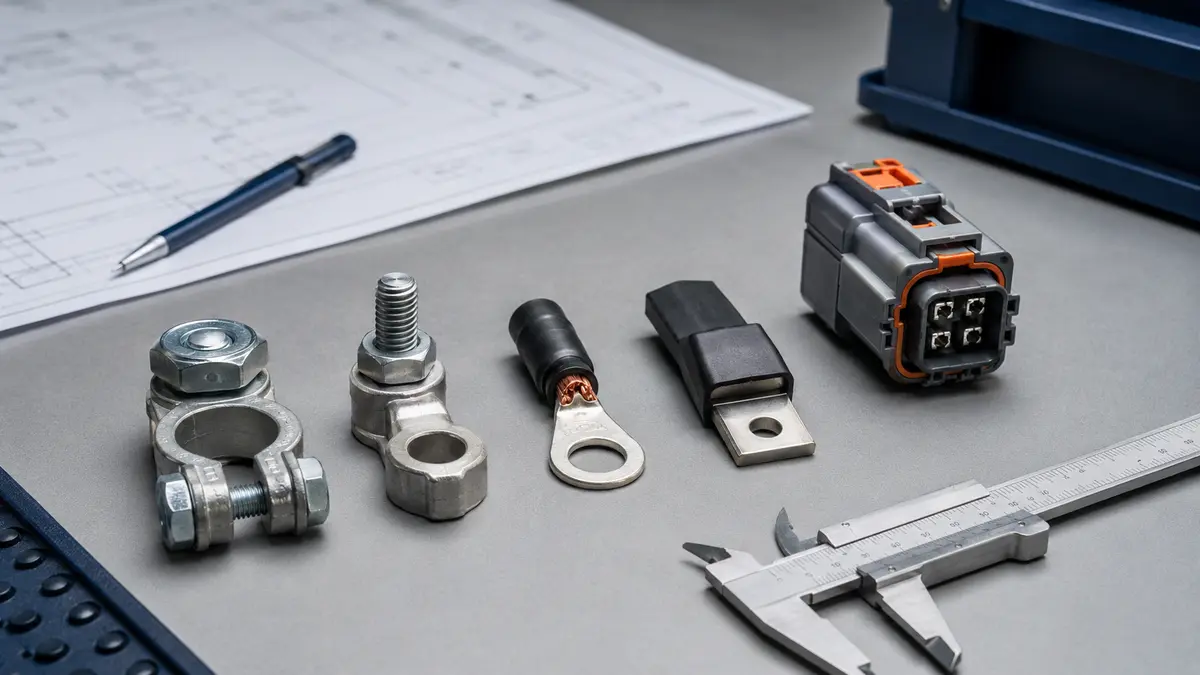
The first selection step is to identify the mechanical architecture. Each terminal style gives the engineer a different balance of retention, service access, cable exit direction, and environmental control.
| Connector Type | Typical Use Case | Strengths | Engineering Review Points |
|---|---|---|---|
| Top post clamp terminal | Lead-acid and starter battery applications where a clamp attaches around a post | Easy to inspect and service; familiar to many maintenance teams | Confirm clamp fit, tightening guidance, corrosion protection, and vertical clearance |
| Side post terminal | Battery compartments where cable exit direction and low profile routing matter | Can reduce top-side space demand and simplify side cable routing | Confirm thread engagement, service torque guidance, washer stack, and access for tools |
| Threaded stud with ring lug | Deep-cycle batteries, industrial packs, marine-style installations, and power distribution points | Strong mechanical retention when the lug, washer, and nut stack are specified correctly | Confirm lug hole fit, terminal material, anti-rotation control, strain relief, and sealing method |
| Flat blade tab terminal | Small sealed batteries and compact service-replaceable modules | Fast assembly and compact packaging | Confirm vibration exposure, retention force, mating tab geometry, and accidental disconnect risk |
| Pluggable rectangular power connector | Removable packs, chargers, modular equipment, and systems requiring repeated mating | Can combine housing protection, polarization, latching, and service-friendly disconnection | Confirm contact rating, keying, latch retention, cable termination, and environmental sealing |
| Two-position battery connector | Portable packs, battery modules, and compact power devices where positive and negative contacts are grouped | Simple polarity control and compact assembly path | Confirm pitch, contact spacing, polarization, wire gauge support, and whether signal contacts are also required |
Battery Charger Connector Types Need a Different Review
Battery charger connector types are exposed to a different duty cycle from fixed battery terminals. They may be plugged and unplugged by operators, maintenance staff, or automated charging equipment. That makes mating guidance, latching, contact protection, and service replacement more important than they would be in a permanently bolted terminal.
For charger interfaces, engineers should ask whether the connector needs separate power and signal paths, a keyed housing, a latch that resists accidental pull-out, or a sequence that protects the system during connection and disconnection. In lithium systems, charger communication can be as important as the main power path because the battery management system may need a stable reference and reliable signal continuity before charging is allowed.
If a charger port is exposed on the outside of a device or vehicle, the connector review should include enclosure sealing, cable strain relief, contact access, serviceability, and whether a damaged port can be replaced without disturbing the rest of the harness. These points should be discussed early with the supplier, especially for custom cable assemblies or panel-mounted power interfaces.
Lithium Battery Connector Types Require More Discipline
Lithium battery connector types deserve stricter review because pack energy density, electronic control, and thermal limits leave less room for unstable connections. The connector decision should account for contact resistance, temperature rise under the actual duty cycle, BMS signal integrity, operator access, and whether the pack is fixed, removable, or frequently swapped.
A lithium battery interface may need power contacts, signal contacts, keyed housings, secondary locks, touch-safe features, or an interlock path. Those choices should be confirmed through drawings and project-specific validation instead of assumed from a similar-looking connector. A connector that appears mechanically similar may use different terminal plating, housing material, contact geometry, or latch retention.
For LinkManu projects, battery and power interfaces are usually reviewed alongside the broader Power Connectors for DC and High-Current Interface Projects family. That review helps clarify whether the project needs a standard power connector, a modified terminal, a cable assembly, or a custom connector approach.
2 Pin Battery Connector Types for Compact Modules
2 pin battery connector types are common when the pack only needs positive and negative power contacts in a compact interface. They can be useful for portable electronics, removable modules, small power packs, and service-replaceable assemblies. The apparent simplicity is useful, but it can also hide important design questions.
- Polarity control: The housing should help prevent reverse insertion or accidental polarity reversal.
- Retention: The latch or friction system should match the vibration and handling conditions of the finished equipment.
- Wire support: The terminal and housing should support the required conductor size, insulation diameter, and cable bend path.
- Thermal behavior: Temperature rise should be reviewed under the actual load profile, enclosure airflow, and contact condition.
- Service access: A compact connector still needs enough space for assembly, inspection, and safe disconnection.
- Future signals: Smart batteries may need more than two contacts if identification, sensing, or communication is required.
How to Replace Battery Cable Connectors Safely
Many readers search for how to replace battery cable connectors because a field issue has already appeared. The safe answer is not to copy the old part by appearance alone. Replacement work should follow the battery maker, equipment maker, and connector maker documentation. When the application involves stored energy, high current, or regulated equipment, the work should be handled by qualified personnel.
- Make the equipment electrically safe. Follow the approved shutdown procedure, verify the energy state, and use the required personal protection and tools for the system.
- Identify the terminal architecture. Confirm whether the connection is a clamp, side post, threaded stud, flat blade, pluggable connector, or a custom pack interface.
- Inspect the cable condition. Look for corrosion, blackened strands, insulation damage, loose heat shrink, overheated terminals, and unsupported cable weight.
- Select the correct lug or connector family. Match the conductor, terminal shape, mounting hardware, insulation support, and environmental exposure through documentation, not visual similarity alone.
- Use the specified crimp or termination process. The tool, die, strip length, barrel type, and inspection method should match the terminal supplier guidance.
- Verify after assembly. Check mechanical retention, cable strain relief, polarity, contact seating, and loaded operation according to the equipment procedure.
How to Replace a Battery Terminal Connector Without Repeating the Failure
When deciding how to replace a battery terminal connector, the most important question is why the original connection failed. If corrosion, vibration, over-tightening, cable pull, heat, or a poor crimp caused the issue, installing the same style without correcting the cause may only reset the clock.
A practical replacement review should compare the old terminal against the battery post or pack terminal, the cable lug, the washer stack, the housing clearance, the seal, and the service environment. A different terminal style may be appropriate, but it should not be described as a direct substitute unless the equipment documentation and supplier data support that decision.
Procurement caution: Avoid replacement or compatibility promises unless the supporting drawings, test records, and approval documents prove the match for the specific equipment.
Supplier Capabilities That Reduce Battery Connector Risk
For B2B power projects, the supplier review should go beyond a simple catalog comparison. Connector reliability depends on terminal geometry, tooling control, stamping quality, housing molding, assembly consistency, and final inspection. LinkManu’s available manufacturing capability references include tooling, stamping, injection molding, and assembly, which are important when a project needs controlled connector production rather than a one-off sourcing match.
Certification references also matter in supplier qualification. LinkManu’s available certification references include IATF 16949 and ISO 14001. These references should be reviewed together with the actual scope, project requirements, inspection plan, and customer documentation needs.
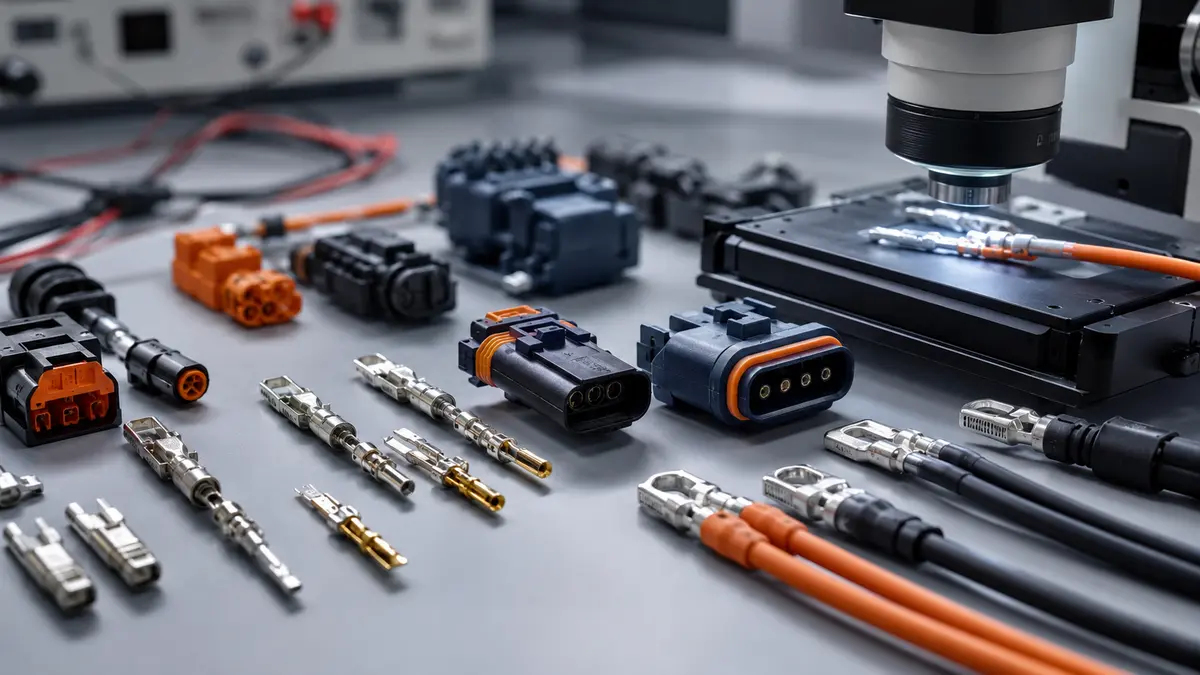
When you compare battery terminal connector types for a new product, ask suppliers to clarify the evidence behind each recommendation. Useful review items include drawing availability, material and plating details, contact design, cable termination process, sample readiness, quality inspection method, and whether the supplier can support changes before production release. You can also review related connector families from the LinkManu Products overview or contact LinkManu for project-specific discussion.
Frequently Asked Questions About Battery Terminal Connector Types
What are the different types of battery terminal connectors?
Common battery terminal connector types include top post clamp terminals, side post terminals, threaded stud terminals with ring lugs, flat blade tab terminals, pluggable rectangular power connectors, and two-position battery connectors. The right type depends on battery format, cable routing, service access, retention needs, and environmental exposure.
What are the different types of terminal connectors beyond automotive batteries?
Beyond automotive-style battery posts, industrial power systems may use ring terminals, bolted studs, terminal blocks, rectangular power connectors, wire-to-board power connectors, and mixed power-plus-signal interfaces. The application decides which architecture is appropriate.
How do lithium battery connector types differ from lead-acid battery terminals?
Lithium battery connector types often require tighter review of contact stability, temperature rise, BMS signal continuity, keying, latching, and operator safety. Lead-acid battery terminals are often more mechanically familiar, but they still require corrosion control, cable support, and correct service procedures.
How should I choose between battery charger connector types?
Compare the charger connector by mating frequency, latch design, cable strain relief, sealing, polarity control, power and signal requirements, and service replacement needs. For a lithium charger interface, confirm the connector choice with the battery management and charging strategy before final sourcing.
Can I replace a battery terminal connector with a similar-looking part?
Do not rely on appearance alone. A similar-looking connector may differ in material, plating, contact design, terminal fit, housing geometry, or termination process. Confirm the replacement through equipment documentation, connector drawings, and supplier review.
Send Your Connector Requirement
Share your drawing, BOM, target application, cable requirement, battery interface, or charger interface. LinkManu can review connector fit, sample options, documentation needs, and RFQ readiness before final selection.

Technical content reviewed by LinkManu Engineering Team
Prepared by LinkManu Editorial Team for B2B connector engineers, sourcing teams, and product development projects. Updated 2026.