Wire Harness Engineering Guide
What Does a Wiring Harness Do? Functions, Risks, and Connector Selection
A wiring harness organizes wires, terminals, connectors, seals, and protective coverings into one controlled electrical assembly. Its job is not only to carry power or signals, but also to make routing repeatable, reduce assembly mistakes, protect conductors from mechanical stress, and make service work easier. For engineers and sourcing teams, the better question is not simply what does a wiring harness do, but whether the harness design, connector choice, and production controls match the real operating environment.
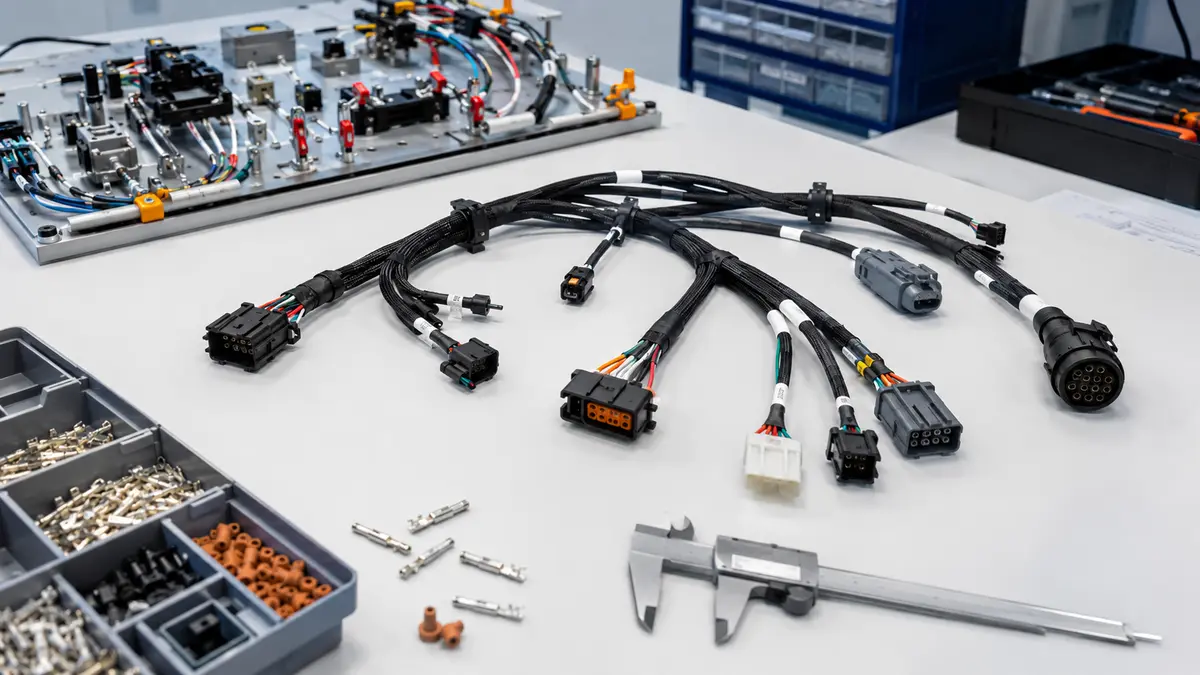
When a harness is specified late, small assumptions can become expensive field problems. A connector that looks acceptable in a prototype may be difficult to assemble at scale. A terminal that passes a simple continuity check may still loosen under vibration. A sleeve that protects one branch may fail in a tighter routing path. This guide explains the core functions of a harness, the failure modes that matter, and the selection questions to confirm before a design moves into production.
Why Wiring Harness Problems Disrupt Production
A burnt wiring harness is usually a symptom, not the root cause. The visible damage may be melted insulation, darkened terminals, or a deformed connector housing, but the decision that created the risk often happened earlier: conductor sizing was not reviewed against the load, terminal plating was not checked for compatibility, strain relief was too weak for the routing path, or sealing was not matched to moisture and dust exposure.
In production, these issues rarely stay isolated. One intermittent contact can trigger false diagnostics. One harness branch routed too close to a moving surface can create repeat service calls. One poorly retained terminal can increase resistance, heat, and downtime. For B2B equipment builders, harness reliability is therefore a design, sourcing, and quality-control question at the same time.
Failure Modes Engineers Should Catch Early
- Loose or poorly seated terminals: can pass an initial check yet create intermittent opens during vibration or repeated handling.
- Insulation wear: can appear where harness branches pass through tight spaces, near moving parts, or against sharp edges without enough abrasion protection.
- Material mismatch: can increase corrosion risk when terminal plating, connector material, and the operating environment are not reviewed together.
- Weak strain relief: can transfer cable pull directly into the crimp or terminal retention area.
- Late connector selection: can force compromises in mating direction, service access, assembly speed, or documentation readiness.
Engineering note: If a project mentions current, voltage, temperature, sealing, mating cycle, or vibration requirements, treat those as values to confirm with datasheets, samples, and validation testing. Do not rely on a general connector category as proof of fit.
What Does a Wiring Harness Do in an Electrical System?
From an engineering perspective, a harness converts many individual electrical paths into a controlled physical assembly. It keeps circuits organized, protects wires from stress, and gives the production team a repeatable way to install the same electrical layout across every unit. Compared with loose point-to-point wiring, a harness reduces routing variation and makes inspection easier.
Core Components and Their Roles
- Conductors: carry power, ground, sensor, control, or communication signals through the product.
- Insulation: separates circuits and protects conductors from heat, abrasion, chemicals, and handling damage.
- Terminals: create the electrical interface between wire and connector contact.
- Connector housings: provide polarity, terminal retention, locking, and a separable mating interface.
- Seals, grommets, and backshells: support environmental protection and strain relief where the harness enters a connector or enclosure.
- Tape, conduit, braid, or sleeving: protect the harness bundle and help control bend, abrasion, and routing behavior.
What is a wire harness in practical terms? It is a bridge between electrical design and physical installation. It must respect circuit requirements, connector fit, assembly ergonomics, service access, and production inspection. A good harness makes the product easier to build; a weak harness turns every installation into a variable process.
Electrical and Mechanical Functions
What does the wiring harness do beyond carrying current? It helps manage voltage drop, signal routing, shielding needs, branch separation, strain relief, and connector access. For signal circuits, the harness layout can influence noise pickup and communication stability. For power circuits, conductor choice, crimp quality, and connector contact design affect heat and resistance. Mechanically, the harness must survive flexing, handling, installation forces, and the stress created by the surrounding product structure.
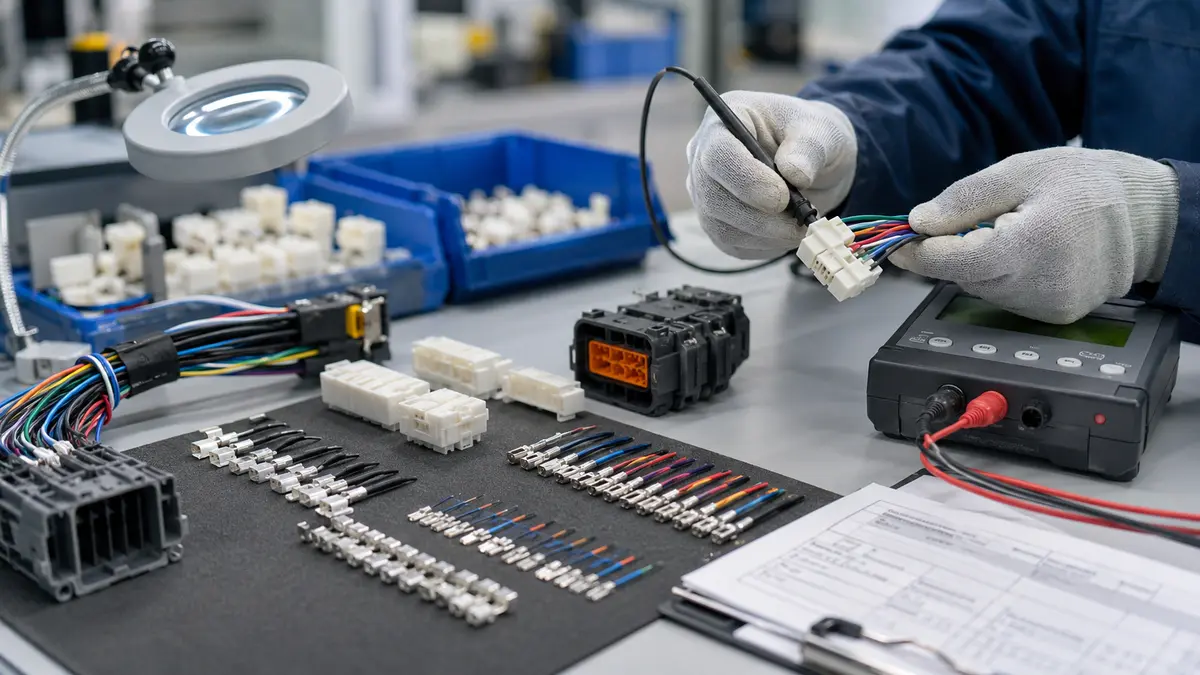
Why Harness Specification Should Not Be an Afterthought
Many projects treat the harness as a late procurement item after the enclosure, PCB, and mechanical layout are nearly frozen. That approach increases risk. If connector direction, service clearance, branch length, or protection material is chosen after the surrounding product is fixed, the harness supplier may have little room to improve manufacturability.
The result can be a lower initial unit price but higher downstream cost. Rework, scrap, service visits, supplier disputes, and rushed redesigns often cost more than an early design review. For custom projects, LinkManu recommends reviewing drawings, BOM data, operating environment, and connector samples before tooling or mass production decisions are locked.
Cost and Risk Comparison
| Decision Area | Early Engineering Review | Late Low-Cost Sourcing |
|---|---|---|
| Connector fit | Mating direction, locking, service access, and documentation are checked before sample approval. | Fit issues may appear during assembly or field service, when changes are harder to make. |
| Terminal and crimp quality | Crimp tooling, pull-force expectations, and inspection method are defined with the supplier. | Weak process control may create intermittent faults that are hard to diagnose later. |
| Protection strategy | Sleeving, tape, conduit, and strain relief are matched to routing and handling conditions. | Protection may be chosen by price or availability rather than real installation stress. |
| Documentation | Drawings, BOM, samples, and inspection requirements can be aligned before production. | Missing documents can delay approval, incoming inspection, and supplier qualification. |
Electrical Wire Harness Design Questions to Confirm
A reliable electrical wire harness design is built from connected decisions. Wire size affects heat and voltage drop. Insulation affects flexibility, abrasion resistance, and environmental fit. Connector plating affects corrosion behavior and service life. Branch layout affects installation, maintenance, and mechanical stress. Each choice should be confirmed against the application, not copied from a generic example.
Key Selection Factors
| Factor | What to Confirm | Why It Matters |
|---|---|---|
| Electrical load | Continuous current, peak current, voltage, grounding, and acceptable voltage drop. | Under-specified conductors or contacts can increase heat and reduce system reliability. |
| Signal requirements | Whether circuits need shielding, twisted pairs, controlled routing, or separation from noisy power lines. | Signal circuits can be affected by poor routing, crosstalk, or inadequate shielding strategy. |
| Connector interface | Mating direction, latch design, terminal retention, service access, and available space. | A connector that fits electrically may still fail the assembly or service workflow. |
| Environment | Moisture, dust, heat, chemicals, vibration, flexing, and abrasion exposure. | Materials and protection methods should match the real installation conditions. |
| Manufacturing readiness | Crimp tooling, inspection criteria, sample validation, labeling, and drawing control. | Clear production rules reduce variation between prototype and mass production builds. |
Mechanical and Environmental Review
Mechanical fit should be reviewed early. Ask how the harness will be routed, where it will be clipped, how much movement it will see, which areas need abrasion protection, and how technicians will mate or unmate connectors. If the harness is installed near heat, fluids, moving parts, or outdoor exposure, material choices should be confirmed with supplier documentation and sample testing.
For LinkManu projects, the Custom Cable Assemblies & Wire Harnesses Manufacturer | LinkManu page is the main product-family reference for harness and cable assembly work. For unusual space constraints, molded features, or non-standard interfaces, a Custom Connectors review may also be appropriate.
Types of Wire Harness Connectors and How to Compare Them
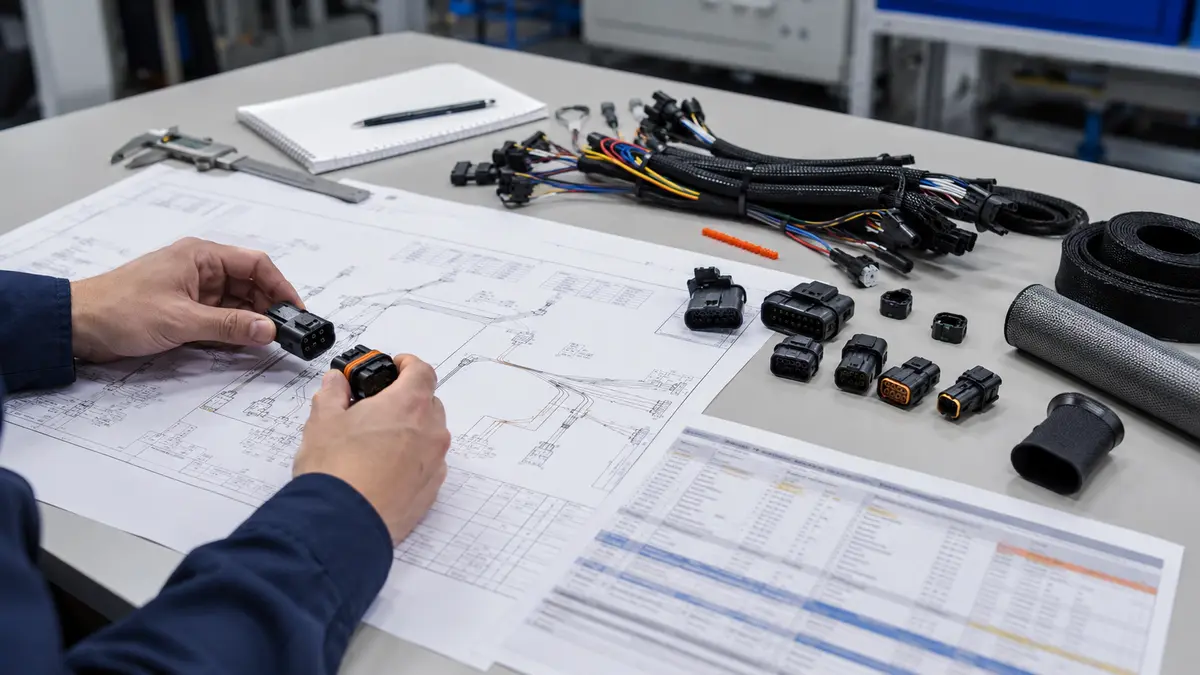
The types of wire harness connectors used in a project depend on the circuit, environment, size limit, and service requirement. A wire-to-wire connector may be suitable for an inline branch. A wire-to-board connector may connect the harness to a PCB or controller. Circular or ruggedized interfaces may be considered for harsher mechanical environments. RF or coaxial interfaces may be needed where high-frequency signal integrity is part of the design.
Connector Family Comparison
| Connector Family | Typical Role | Selection Questions |
|---|---|---|
| Wire-to-wire | Connects one harness branch to another harness branch. | Is locking secure, polarity clear, and environmental protection suitable? |
| Wire-to-board | Connects harness wiring to a PCB, module, or controller. | Does the mating direction fit the enclosure and assembly sequence? |
| Circular or rugged connector | Supports applications needing stronger coupling or environmental protection. | Is the shell, coupling method, sealing, and strain relief matched to the application? |
| RF or coaxial | Routes high-frequency signal paths such as antenna or communication circuits. | Are impedance, shielding, bend radius, and connector termination controlled? |
| Mixed signal and power | Combines multiple circuit types in one interface. | Are spacing, heat, routing, and assembly inspection requirements clearly defined? |
What Is a Connector in a Wiring Harness?
A connector in a wiring harness is the separable electrical and mechanical interface between circuits. It normally includes a housing, terminals, locking features, and sometimes seals, backshells, or strain relief elements. The connector must hold terminals securely, guide correct mating, protect the contact area, and allow the harness to be assembled and serviced without damaging the crimp or wire.
How to Select Connector in Wiring Harness Projects
- Define the circuit: document voltage, current, signal type, grounding, and any shielding or separation needs.
- Map the environment: confirm moisture, dust, temperature, chemicals, vibration, bending, and service exposure.
- Review the mechanical fit: check connector direction, latch access, retention, branch exit, and installation sequence.
- Confirm documentation: request drawings, crimp requirements, material notes, sample approval records, and inspection criteria.
- Validate samples: use functional checks and supplier review before releasing the design to production.
Practical sourcing rule: If a supplier cannot explain the connector family, terminal choice, crimp method, and inspection plan, the harness quote is not yet production-ready.
Testing, Documentation, and Supplier Qualification
Harness quality depends on both design and process control. A drawing may specify the right connector, but the production result still depends on terminal insertion, crimp control, wire cutting, stripping, routing, labeling, and final inspection. For engineering and sourcing teams, the supplier discussion should include both product fit and production method.
Useful review topics include continuity checks, insulation checks where applicable, crimp pull verification, connector terminal seating, dimensional checks against the drawing, and sample documentation before volume build. LinkManu-related source facts for this article reference assembly, tooling, stamping, injection molding, IATF 16949, and ISO 14001. These facts should be used as starting points for project documentation requests, not as a substitute for application-specific validation.
Teams comparing suppliers can also review the broader Products structure to understand where wire harness work connects with connector families, custom interfaces, and application-specific assembly needs. When the project is ready for document review, the Get Engineering Review route is the simplest next step.
Conclusion: A Harness Is a Designed Subsystem
A wiring harness does far more than bundle wires. It organizes electrical paths, supports repeatable installation, protects conductors, controls connector interfaces, and helps the final product survive its operating environment. The strongest harness decisions are made before production pressure starts: confirm the electrical requirements, map the routing path, compare connector options, validate samples, and align the inspection plan with the supplier.
If you are reviewing a new harness, share the drawing, BOM, target application, connector requirement, and any known operating constraints. A structured review can help identify missing information before those gaps become assembly delays or field issues.
Frequently Asked Questions
What is the main purpose of a wiring harness?
The main purpose of a wiring harness is to consolidate wires into a protected, organized assembly that simplifies installation, reduces routing variation, and supports reliable power or signal distribution inside a product.
What is a connector in a wiring harness?
A connector is the mating interface that joins harness circuits to another harness, PCB, module, sensor, actuator, or power device. It includes terminals and a housing, and may also include seals, locks, backshells, or strain relief.
When selecting terminals to use for wiring harnesses, what is considered?
Engineers should consider circuit load, mating terminal material, plating compatibility, crimp method, retention, environmental exposure, and the supplier’s inspection process. Exact values should be confirmed from the approved datasheet and application test plan.
How do you select a connector in a wiring harness?
Start with electrical requirements, then review environmental exposure, mechanical fit, assembly access, documentation, and sample validation. A connector should not be approved only because it mates physically; it must fit the full use case.
What causes a burnt wiring harness?
A burnt wiring harness can result from heat, overload, short circuits, loose terminals, poor crimp quality, damaged insulation, or environmental damage. The visible burn should trigger a root-cause review of the circuit, connector, routing, and production process.
Send Your Connector Requirement
Share your drawing, BOM, target application, or technical requirements. LinkManu can review connector fit, sample options, documentation needs, and RFQ readiness before final selection.

Prepared by LinkManu Editorial Team for B2B connector engineers, sourcing teams, and product development projects. Updated 2026.