
Power Connector Selection Guide
Types of AC Power Connectors: Selection Guide
Choosing among the main types of AC power connectors should start with the equipment drawing, not a catalog thumbnail. The connector has to match the line connection, enclosure layout, assembly method, service access, and the environment around the machine. A part that looks acceptable on a bench can become a warranty problem if the cable bend radius, contact retention, heat path, or documentation package was never checked.
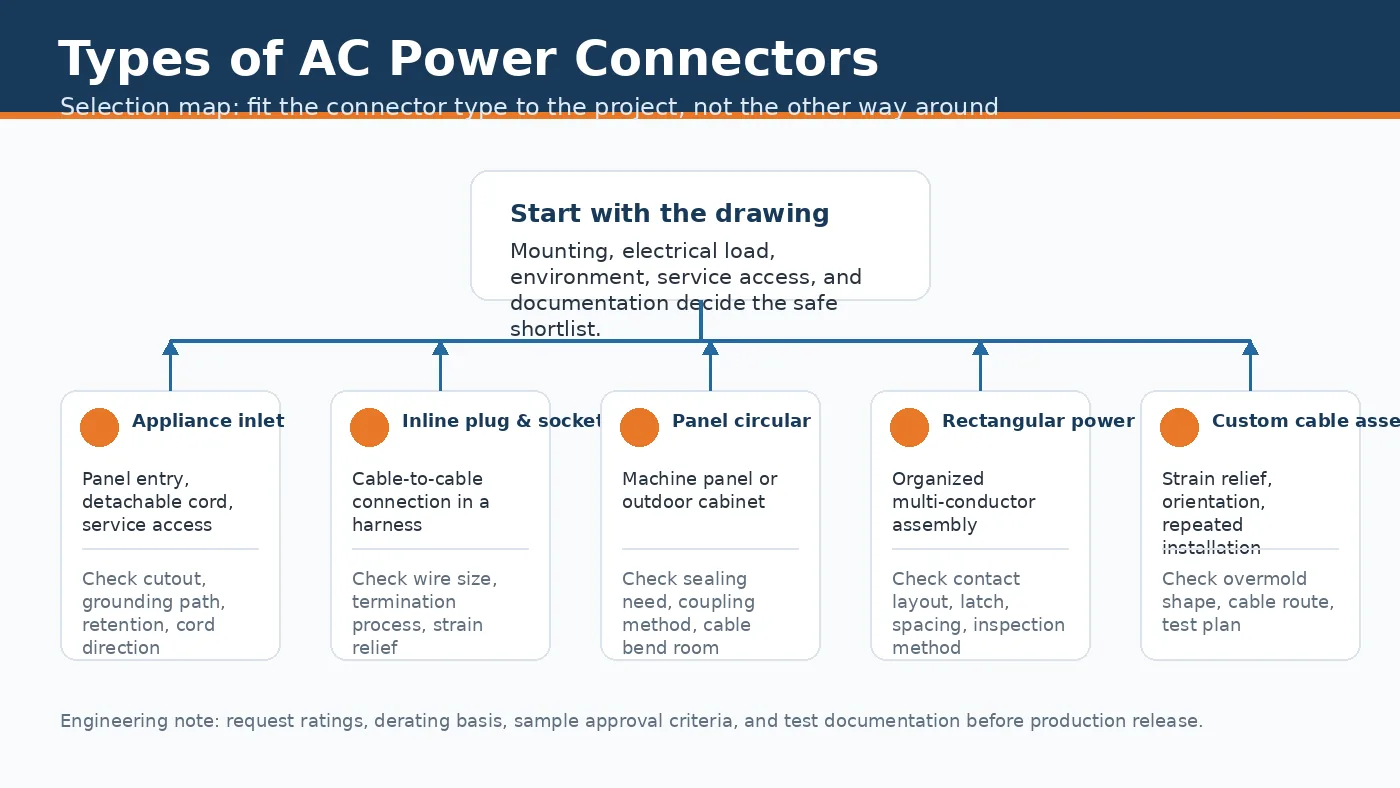
Quick engineering check: before naming a connector type, confirm the mounting position, conductor assignment, current and voltage requirements, ambient temperature, cable strain relief, expected mating frequency, and any test documentation the customer or market requires.
Common Types of AC Power Connectors and When They Fit
The useful way to group AC connector types is by how the power enters the equipment and how often the connection will be handled. A fixed indoor device may only need a compact inlet and cord set. A serviceable industrial enclosure may need a panel-mounted connector with stronger retention and clearer wiring control. A moving machine or outdoor box may need a sealed cable assembly and a coupling method that will not loosen during vibration.
| Connector type | Where it often fits | Engineering check before RFQ | Procurement risk if skipped |
|---|---|---|---|
| Appliance-style inlet or outlet | Detachable cord entry for equipment that needs simple service access. | Confirm panel cutout, retention, grounding path, safety documentation, and cord direction. | A late enclosure change may force a new cutout or different cord set. |
| Inline AC plug and socket | Cable-to-cable power connection inside or near an equipment harness. | Check wire size, crimp or solder process, strain relief, polarity control, and service handling. | Loose termination or unclear assembly instructions can create intermittent faults. |
| Panel-mount circular connector | Machine panels, outdoor cabinets, and equipment that needs stronger mechanical coupling. | Review sealing requirement, mating access, anti-loosening method, shell clearance, and cable bend space. | A connector may fit electrically but fail the enclosure or service layout review. |
| Rectangular power connector | Multi-conductor assemblies where power, ground, and auxiliary contacts need organized routing. | Confirm conductor count, contact layout, latch design, spacing, and assembly inspection method. | Procurement may buy a housing family that cannot support the final wiring plan. |
| Custom cable assembly or overmolded connector | Repeated installation, moisture exposure, strain relief control, or branded equipment harnesses. | Define cable jacket, connector orientation, overmold geometry, test scope, and sample approval criteria. | Tooling can move forward before the cable route and field replacement plan are settled. |
If the project also involves DC power distribution, board connections, or high-current interface work, LinkManu’s Power Connectors for DC and High-Current Interface Projects page is the closest product-category reference. For AC projects, use it as a capability reference, then confirm the actual drawing, cable, and safety requirements for the specific connector.
Why Off-the-Shelf Types of AC Power Connectors Can Miss the Application
Off-the-shelf availability is useful, but it does not prove application fit. Two connectors in the same broad family can differ in terminal retention, contact geometry, housing material, latch behavior, and assembly process. A purchasing team should therefore ask whether the part was chosen because it meets the application or because it was easy to source.
The first risk is temperature rise. Published current numbers do not replace a review of enclosure heat, cable size, duty cycle, and contact interface. If the connector is boxed into a warm cabinet or routed near a heat source, the practical margin can shrink. The RFQ should ask for the rating basis, any derating guidance, and whether temperature-rise or hi-pot testing is needed for the final assembly.
The second risk is mechanical movement. Vibration, cable pull, and repeated service can expose a weak latch or marginal strain relief. For equipment that will be opened in the field, the connector should be checked for mating direction, touch access, torque or latch process, and whether the installer can verify full engagement without guessing.
Procurement Costs Hidden Inside the Wrong Connector Type
A low piece price can become expensive when the connector creates rework. Common cost drivers include changed panel openings, replacement harnesses, failed incoming inspection, missing documentation, and production delays while engineering approves a substitute. The safer purchasing question is not “Which connector is cheapest?” but “Which connector can pass drawing, assembly, and documentation review with the fewest late changes?”
- Enclosure mismatch: the chosen inlet or panel connector does not leave enough clearance for nut, gasket, cable bend, or operator access.
- Assembly mismatch: the terminal process needs tooling, inspection, or operator training that was not planned in the production line.
- Documentation gap: the part cannot provide the drawing, material notes, test records, or certification scope needed by the customer audit.
- Service mismatch: the connector works during factory assembly but is difficult to replace or inspect after installation.
These issues should be caught before sample approval. If the supplier only quotes a part number, procurement still has to carry the application risk. If the supplier reviews the drawing, cable, mounting method, and test expectations together, the quotation is more likely to reflect the real project.
How to Specify Types of AC Power Connectors for an RFQ
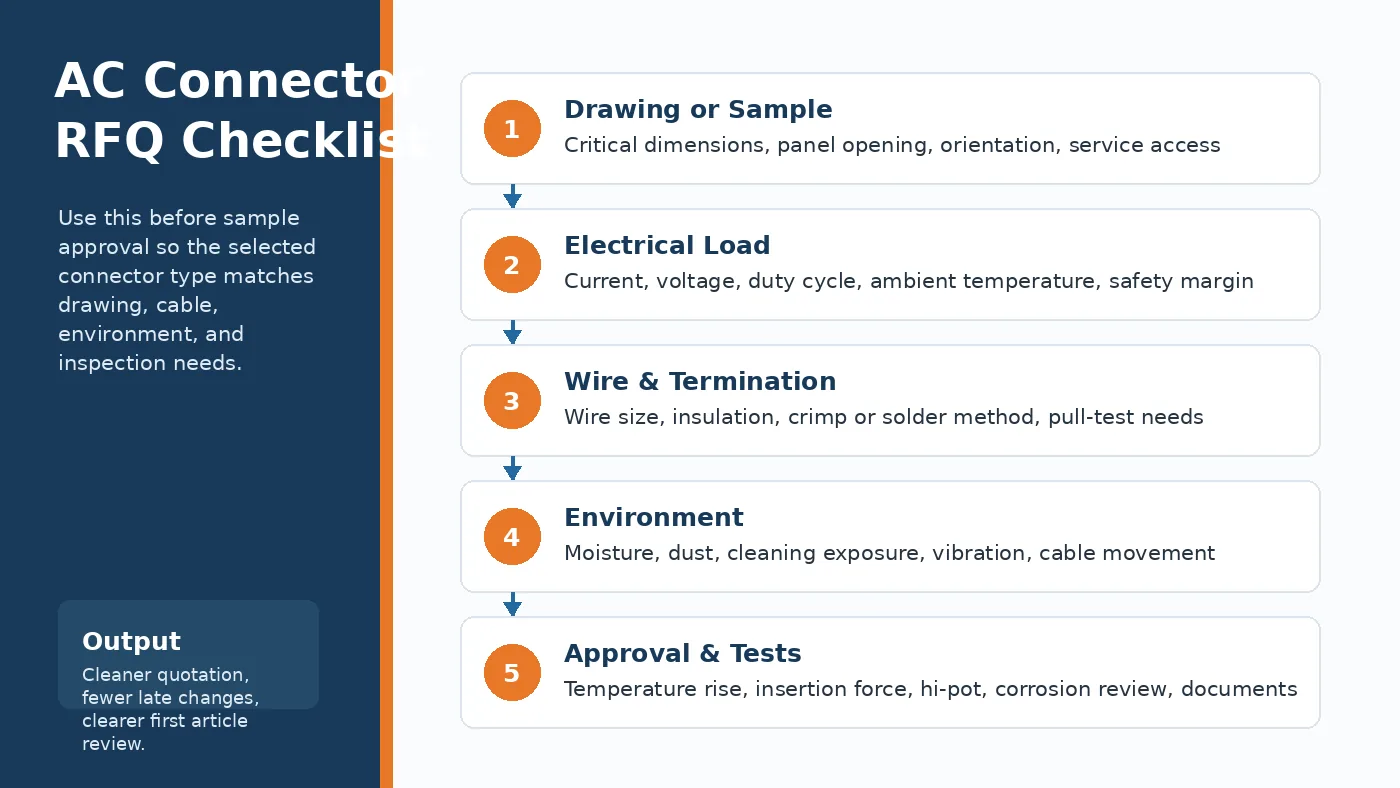
An RFQ for AC connector selection should read like an engineering handoff. It does not need to be long, but it should remove the assumptions that cause late changes. At minimum, include the drawing or sample, conductor assignment, current and voltage requirements, wire or cable details, mounting method, environment, and any requested tests.
| RFQ item | Why it matters | What to confirm |
|---|---|---|
| Drawing, sample, or target envelope | Controls fit, mating height, panel opening, and cable route. | Critical dimensions, mounting tolerance, orientation, and service access. |
| Electrical load | Sets the starting point for contact design and thermal review. | Current, voltage, duty cycle, ambient temperature, and safety margin. |
| Wire and termination process | A connector is only as stable as the termination behind it. | Wire size, insulation, crimp or solder method, pull test needs, and inspection plan. |
| Environment | Moisture, dust, chemicals, and vibration change the suitable housing and sealing approach. | Indoor or outdoor use, cleaning exposure, movement, and sealing documentation. |
| Approval and testing | Prevents sample approval from becoming a paperwork problem later. | Temperature rise, insertion and extraction force, hi-pot, salt spray, or other project-specific checks. |
When the connector uses contacts similar to other power-contact projects, the same procurement logic applies: do not treat the peak rating as the working condition without checking heat, contact design, and cable assembly. The related article How to Choose the Right Power Contacts for Your Connector Application can help frame those contact-level questions.
Supplier Review: What LinkManu Can Check Before Tooling
For a custom or modified AC connector project, the early supplier review should test whether the concept is manufacturable, inspectable, and repeatable. Company materials list design engineering, mold development, injection molding, stamping, product assembly, and inspection before shipment as process steps. That matters when the connector shape, terminal, and cable assembly need to be reviewed together instead of passed between disconnected suppliers.
Engineering support may include Pro-E modeling, Moldflow analysis, and terminal stress analysis when the project scope requires it. This should not be read as a promise that every connector needs every simulation step. The practical question is simpler: which part of the design carries the risk? For a molded body, it may be wall thickness, gate position, or warpage. For a terminal, it may be retention, spring behavior, or crimp consistency.
Quality checks may include insertion and extraction force testing, hi-pot testing, corrosion-resistance review, or other project-specific checks when required. The buying team should ask for the test plan during quotation, not after the first article sample arrives. If the equipment will be shipped into a regulated market, the documentation scope should also be confirmed before production release.
FAQ: Types of AC Power Connectors
Which AC connector type should I choose first?
Start with mounting style. If the power enters a panel, review appliance-style inlets or panel connectors. If it sits in a harness, review inline or custom cable assemblies.
When does an AC connector need sealing?
Use sealing as a requirement when the connector may see dust, moisture, washdown, outdoor exposure, or cable movement that can pull contaminants into the interface.
Is a standard catalog connector enough?
Sometimes. It still needs drawing fit, current and voltage confirmation, cable strain relief review, and documentation checks before production approval.
What should I send for a custom AC connector review?
Send the drawing or sample, cable details, conductor assignment, mating direction, environment, current and voltage needs, and any required test documentation.
Send Your Connector Requirement
Share the drawing, sample photo, cable route, target current and voltage, environment, mating access, and test documentation needs. LinkManu can review connector fit, RFQ readiness, and sample approval risks before selection is locked.