
Crimp Connector RFQ Guide
How to Use Crimp Connectors in Cable Assembly RFQs
Knowing how to use crimp connectors in a production cable assembly is less about squeezing a terminal once and more about controlling the whole termination path. Engineering and purchasing teams need to confirm the wire, terminal, housing, tooling, inspection method, and sample approval records before a crimped connector enters the BOM. If those items are missing, a sample can look acceptable on the bench and still create intermittent faults after handling, vibration, or production variation.
This guide is written for RFQ preparation, not DIY bench work. It uses the uploaded brief’s cautious angle: crimp terminal selection and inspection questions for cable assembly buyers. For a broader view of connector families that may sit around a crimped harness or connector project, start from LinkManu’s Products page.
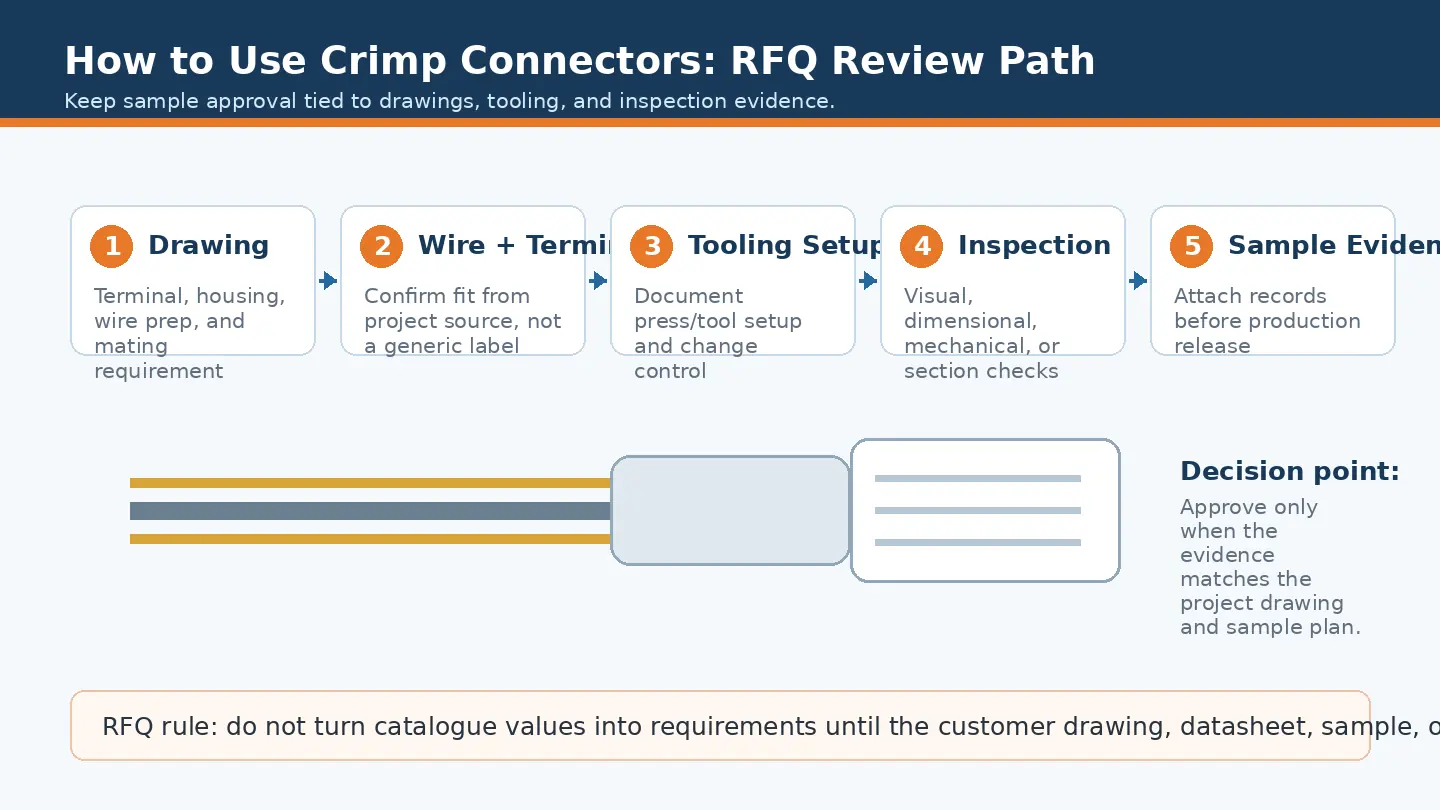
Treat the Crimp as a Controlled Production Process
A crimp connector can fail even when the terminal appears seated. The practical risk is that a weak joint hides inside the housing until cable movement, heat, humidity, or repeated service access exposes it. Before approving a supplier, ask whether the crimp process is controlled by documented tooling setup, operator checks, and measurable inspection criteria. A quote that only says “crimped cable assembly” is not enough for production sourcing.
The first engineering judgment is whether the application can tolerate an unverified termination process. A prototype used for fit review may only need a short build note, but a production harness should define which records are required at first article approval and which checks repeat during later lots. If the design has safety interlocks, power paths, moving cables, or sealed connector shells, the RFQ should ask for a clearer approval trail.
Procurement check: if two suppliers quote the same connector but only one explains terminal matching, strip control, tooling setup, and sample inspection, the lower unit price may be carrying hidden field risk.
Start With Terminal, Wire, and Housing Compatibility
The main selection question is not simply “which crimp connector should we buy?” It is whether the terminal, conductor, insulation, connector housing, and operating environment belong together. The customer drawing, datasheet, sample, or test report should confirm any project-specific parameter before it becomes a public claim or purchasing requirement.
| RFQ Item | Engineering Check | Risk if Skipped |
|---|---|---|
| Wire and terminal match | Ask for the approved wire range, conductor construction, insulation fit, and terminal drawing used for the sample. | Loose conductor grip, cut strands, poor insulation support, or a terminal that cannot be inspected consistently. |
| Connector housing fit | Confirm the terminal retention method, cavity fit, mating direction, and whether service removal is expected. | Backed-out contacts, damaged latches, or assembly workers forcing terminals into the wrong cavity. |
| Material and plating expectations | State the environment and ask the supplier to confirm the terminal material, plating, and compatibility path from project documents. | Corrosion, contact resistance drift, or an unapproved substitution during re-procurement. |
| Tooling and process control | Ask how the crimp tool or press setup is qualified, monitored, and maintained for this terminal and wire combination. | A good first sample followed by lot-to-lot variation after tooling wear or setup changes. |
| Inspection records | Define which visual, dimensional, mechanical, or section checks must be attached to the first article package. | Disputes after a field issue because neither side can show what “approved” meant. |
This is also where generic connector labels become risky. A buyer may search by a broad name, but production approval depends on the exact mating system and drawing control. The related article Electrical wire connector types for General Connector Applications is useful for category orientation, while this RFQ checklist focuses on crimp termination control.
Define What a Good Crimp Must Show
For production work, a “good crimp” should be observable, measurable, or backed by sample evidence. Visual inspection can catch obvious defects, but it should not be the only approval method when the assembly carries power, safety signals, or field-service risk. Ask the supplier which checks are practical for the terminal style and which evidence will be supplied with samples.
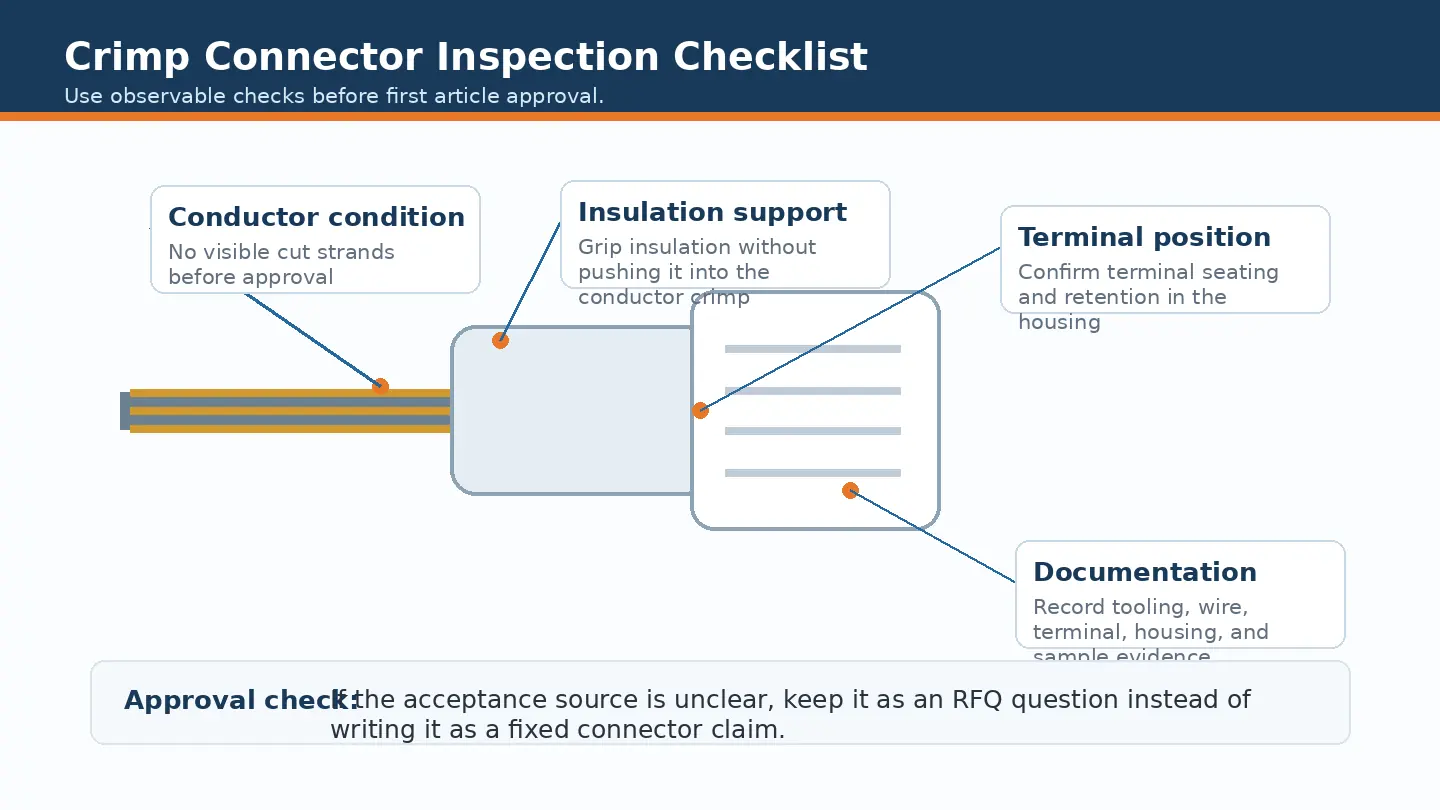
- Confirm the stripped conductor is not visibly damaged before crimping.
- Check that insulation support is present without forcing insulation into the conductor crimp area.
- Review terminal position and retention after insertion into the connector housing.
- Ask whether the project requires pull testing, crimp height checks, or cross-section review, and define the acceptance source.
- Record the tooling, terminal, wire, and housing used for the first approved sample.
- Ask how the supplier handles tooling changes, material changes, and process change notification.
The important condition is traceability. If the drawing does not state acceptance criteria, the RFQ should ask the supplier to identify which customer drawing, datasheet, sample, standard, or test report will be used. Do not turn hidden catalogue values into design rules without confirmation from the actual project source.
Use Supplier Capability Questions, Not Broad Claims
The uploaded brief allows LinkManu-owned facts such as assembly, injection molding, stamping, tooling, and certification references including IATF 16949 and ISO 14001. Those facts are helpful, but they still need project-specific wording. The practical question is not whether a supplier has a capability somewhere in the company profile. It is which process steps, documents, tooling reviews, inspection records, and outside tests apply to this exact crimp connector project.
For custom or modified connector assemblies, ask the supplier to explain the handoff between tooling, terminal forming, molding, assembly, and inspection. A crimp issue may start with a terminal strip, a housing cavity, a wire preparation step, or a late material substitution. Integrated process knowledge can reduce back-and-forth, but the RFQ should still request evidence instead of assuming every project receives the same engineering path.
| Supplier Question | Why It Matters |
|---|---|
| Which drawing controls the terminal, housing, and wire preparation? | Prevents sample approval from depending on verbal descriptions or photo matching. |
| Which inspection results will be included with first article samples? | Gives engineering and purchasing the same baseline for later production lots. |
| Which tests are in-house, and which may need to be arranged externally? | Avoids assuming every environmental or reliability test is standard for every RFQ. |
| How are material, terminal, tooling, or process changes communicated? | Protects re-procurement stability after the first production run. |
Build the RFQ Around Evidence
A useful RFQ package should let the supplier quote the same engineering problem you need solved. Send the assembly drawing, connector family or sample, wire details, operating environment, mating requirement, expected production quantity, and the inspection evidence you need with samples. If the project requires environmental sealing, vibration review, temperature rise, hi-pot, salt spray, or other checks, state that as a confirmation item and ask which documentation can support it.
This is the safest way to use crimp connector guidance in sourcing. The supplier can recommend a terminal and process path, while your team keeps control of the acceptance basis. It also keeps SEO content honest: no invented current, voltage, pitch, temperature, plating thickness, or IP rating is needed to make the article useful.
Frequently Asked Questions
How do you properly use a crimp connector in production?
Match the terminal to the wire and housing, use controlled tooling, inspect the crimp, and keep first article evidence. Do not rely on a one-time bench sample.
What is the most common crimp connector mistake?
Approving a terminal without confirming wire fit, insulation support, tooling setup, and inspection criteria. That creates hidden lot-to-lot risk.
Should a crimp connector RFQ include test requirements?
Yes, if the application needs them. State the required checks as project confirmation items and ask which reports or samples can support them.
Can LinkManu review crimp connector requirements?
Yes. Send the drawing, wire details, connector sample or family, environment, and required documentation so the team can review RFQ readiness.
Next Step Before Sample Approval
Before releasing a crimped assembly for samples, confirm the drawing, terminal family, wire construction, insulation requirement, mating housing, tooling plan, current rating basis, operating environment, and inspection records. If any of those items are unclear, keep them as open RFQ questions instead of turning assumptions into acceptance criteria.
Send Your Connector Requirement
Share your drawing, BOM, target application, or technical requirements. LinkManu can review connector fit, sample options, documentation needs, and RFQ readiness before final selection.

This article is prepared for engineering and sourcing teams that need connector selection checks before sample approval or production quotation.