
Connector Selection Guide
2 pin connector types for Practical Connector Selection
Choosing between 2 pin connector types is rarely just a catalog search. A two-position interface can carry power, a sensor signal, a small actuator lead, or a service disconnect. The part may look simple, but the project risk sits in the details: pitch, mating direction, latch design, wire termination, current rating, temperature exposure, and whether the supplier can document the selected series.
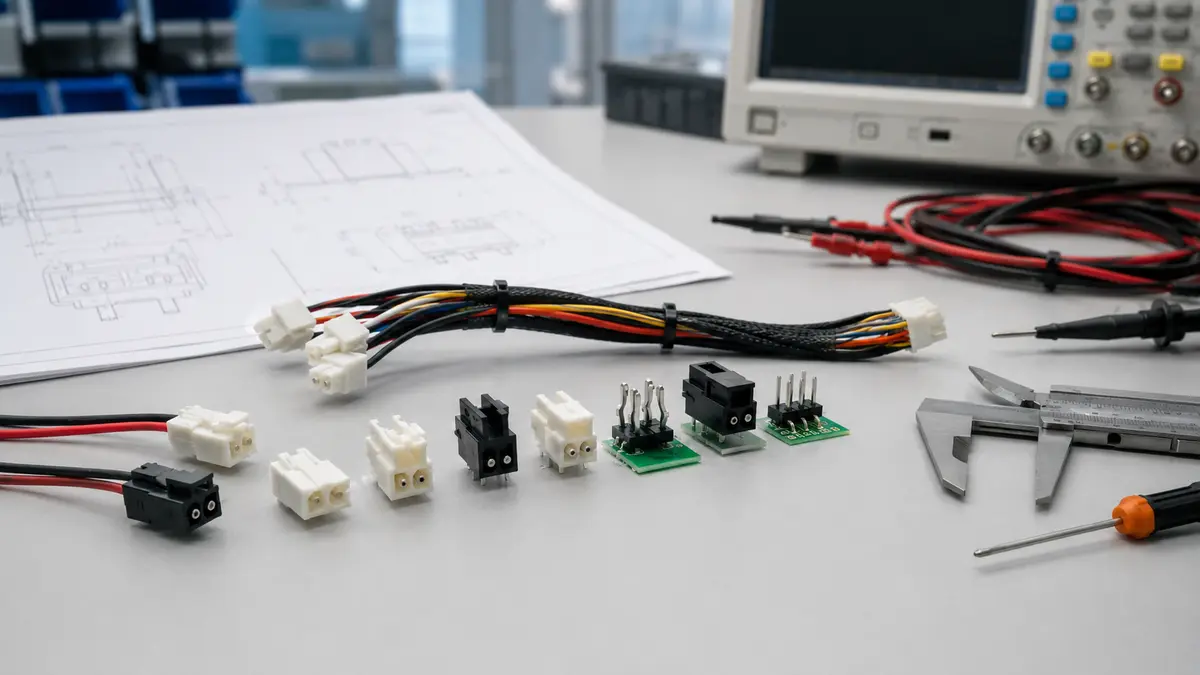
A useful starting point is to separate the connector from the circuit assumption. The same two-position count can be used in wire-to-board, wire-to-wire, panel pass-through, battery lead, lighting, sensor, or general equipment wiring. Procurement should not approve an alternate only because the cavity count and color match. The drawing, mating part, contact system, termination method, and validation evidence all need to line up.
Engineering check: before selecting a part, confirm the drawing, pitch, mating height, wire gauge, current rating, environmental exposure, latch requirement, and test documentation. If any item is unknown, treat the connector as a project review item rather than a quick purchase.
Where two-position connectors cause real project risk
A two-position connector often appears late in the design review because it is small and inexpensive. That is where mistakes happen. If the board header, crimp housing, and terminal are not treated as one mating system, the assembly can pass a bench check and still fail during handling, vibration, or service work. The first procurement question should be simple: are we buying a complete matched set, or are we mixing parts from different records?
For production buyers, the bigger risk is not the unit price. It is the cost of a late change. A connector change may affect the PCB footprint, harness length, crimp tooling, packing method, assembly instructions, and incoming inspection criteria. Even when the electrical function is basic, the supply-chain impact can be larger than expected.
A practical way to compare 2 pin connector types
Start with the application, not the connector image. A power lead, signal lead, battery connection, and service disconnect each need a different review. Ask what the connector must survive after installation: repeated mating, wire pull, enclosure routing, operator handling, heat near the board, cleaning chemicals, dust, moisture, or movement from a motor or fan.
After that, compare the candidate families by measurable project items. For a wire-to-board connection, the board footprint and mating height may decide the shortlist. For an inline harness joint, strain relief and latch security may matter more. For a power path, the current rating, terminal material, contact resistance data, and temperature rise information should be checked against the real load condition instead of assumed from a similar product photo.
LinkManu’s Products page is the required hub for checking which connector families fit the project category. Use it as a navigation point, then confirm the exact part data before approving a BOM item.
Common 2 pin connector formats and what to verify
The table below is not a replacement chart. It is a review guide. A connector can only be treated as interchangeable when the drawing, mating interface, terminal, housing keying, material, and supplier documentation support that decision.
| Format | Typical Project Use | What To Verify Before Buying |
|---|---|---|
| Wire-to-board crimp housing | Harness connection to a PCB header. | Pitch, header orientation, mating height, terminal series, crimp tooling, latch style, and wire gauge range. |
| Board-mounted pin header | Fixed PCB interface for a mating plug or housing. | Footprint, solder process, shrouding, polarization, board clearance, and expected service access. |
| Wire-to-wire inline pair | Harness-to-harness joint for modular assembly or field replacement. | Male and female housing match, terminal retention, latch force, strain relief, and assembly instructions. |
| Sealed two-position connector | Outdoor, automotive, enclosure, or washdown-adjacent wiring. | Seal system, cable diameter fit, terminal lock, mating cycle expectation, and environmental test documentation. |
| Panel or bulkhead style | Connection through an enclosure wall or equipment panel. | Panel cutout, mounting hardware, sealing method, service direction, and cable bend space. |
Gender, socket, and mating direction should be specified clearly
In purchasing discussions, “male,” “female,” “plug,” and “socket” are often used loosely. That creates ordering errors. The safer method is to name the contact type and the assembly side: board header with pins, harness housing with receptacle terminals, inline plug housing, inline receptacle housing, or panel-mounted receptacle. The drawing should show which side carries the pins and which side is touched during service.
This matters for safety and assembly. If the powered side can be exposed during maintenance, the design may need a different gender arrangement or protective shrouding. If the harness can be installed backwards, a keyed or polarized housing should be reviewed. These are not marketing details; they decide whether an operator can mis-mate the connector on the line.
Termination choice affects tooling, repair, and quality control
Crimp, solder, and insulation-displacement terminations solve different manufacturing problems. Crimp contacts are common in harness work because the wire can be prepared away from the board, but quality depends on terminal choice, applicator setup, pull checks, and visual inspection. Soldered headers simplify the board interface, but they do not solve harness strain or field replacement by themselves.
If production volume is rising, the buyer should ask whether the supplier can support the selected termination with tooling guidance and inspection criteria. A connector that is easy to sample by hand may become unstable in production if the crimp window, insulation support, or terminal insertion process is not controlled.
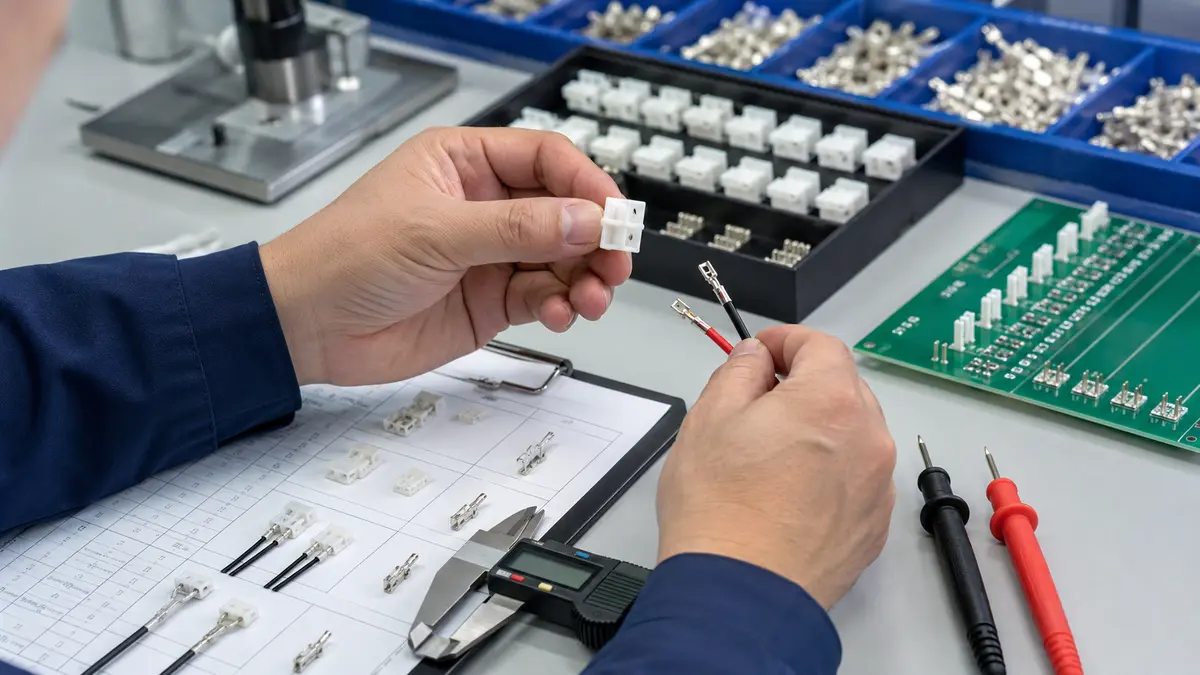
Power, signal, and battery leads need different checks
A two-position connector used for power should be reviewed for load, heat, wire size, contact material, and derating information. A two-position connector used for a low-level signal should be reviewed for stable contact pressure, plating suitability, vibration exposure, and whether service handling can loosen the interface. These checks are different, even when the connector shape looks similar.
For battery or equipment power wiring, the connector review should also look at polarity control, cable strain relief, enclosure routing, and how the assembly will be disconnected during service. If your project is closer to battery wiring than signal wiring, the related guide on battery terminal connector types can help frame the procurement questions before final part review.
Wire-to-board and wire-to-wire are not interchangeable decisions
Wire-to-board is usually chosen when the connector must land directly on a PCB. The board layout, header orientation, solder process, and mating height become part of the connector decision. Wire-to-wire is usually chosen when the design needs modular harness assembly, easier service replacement, or separation between subassemblies.
When the project is still early, compare both architectures before locking the board. A wire-to-board choice may reduce parts but limit service access. A wire-to-wire choice may add a mating pair but simplify installation. The correct answer depends on the product layout, not on connector popularity.
Procurement check: if a supplier suggests an alternate 2 pin connector, request the mating drawing, terminal drawing, housing material information, current rating method, packaging details, and sample validation plan before changing the approved BOM.
Manufacturing capability should support the connector choice
For a standard connector, supplier capability still matters. The files provided for this article list LinkManu capability references including tooling, injection molding, stamping, and assembly. Those capabilities are relevant because two-position connectors depend on small dimensional details: housing fit, contact retention, latch feel, terminal insertion, and crimp consistency.
The same files also list certification references including IATF 16949 and ISO 14001. Those references should be used as procurement context, not as a shortcut around part validation. Buyers should still request project-specific drawings, samples, inspection points, and any required test documentation for the selected connector family.
For broader wire termination choices, see types of wire connectors. If the project expands beyond a two-position interface, the guide on types of electric wire connectors can help compare wider connector categories.
What to confirm before sending an RFQ
A useful RFQ does not need to be long, but it should remove guesswork. Send the connector drawing or mating part, circuit use, wire size, expected current rating, operating environment, latch requirement, preferred termination, sample quantity, and any required inspection or test documents. If only a photo is available, mark the item as a matching review rather than a confirmed replacement.
The next step is practical: confirm drawing, pitch, mating height, current rating, wire gauge, environment, required documentation, and supplier capability. Once those details are available, the connector can be reviewed as a production item instead of a visual guess.
Frequently Asked Questions
What are the main specifications of a 2 pin connector?
Check pitch, contact style, current rating, voltage rating, wire gauge, termination method, housing material, latch design, mating height, and environmental rating. Use the supplier drawing for the exact part number.
Are all 2 pin connector types interchangeable?
No. A similar housing can have different keying, terminals, latch geometry, material, or mating height. Treat any alternate as unapproved until drawings and samples confirm the fit.
When should I choose wire-to-board instead of wire-to-wire?
Choose wire-to-board when the harness must connect directly to a PCB. Choose wire-to-wire when modular assembly, service replacement, or cable routing is more important.
What should I send for a 2 pin connector RFQ?
Send the drawing, mating connector, wire details, circuit use, current requirement, environment, latch requirement, sample need, and any required test or inspection documents.
Send Your Connector Requirement
Share your drawing, mating part, wire details, current requirement, environment, and sample needs. LinkManu can review the connector fit and help clarify RFQ-ready details before selection.

Technical content reviewed by LinkManu Engineering Team
Prepared by LinkManu Editorial Team for B2B connector engineers, sourcing teams, and product development projects. Updated 2026.