Wire Harness Selection Guide
Burnt Wiring Harness: Inspection, Selection, and Supplier Review Guide
A burnt wiring harness usually starts before anyone sees melted plastic. The early signs are electrical and mechanical: a loose terminal, corrosion at the contact area, poor crimp control, a strained cable exit, or a connector selected without enough margin for the real operating environment. For engineers and sourcing teams, the practical question is not only how to replace the damaged harness. It is how to identify the weak condition that allowed the heat event to happen.
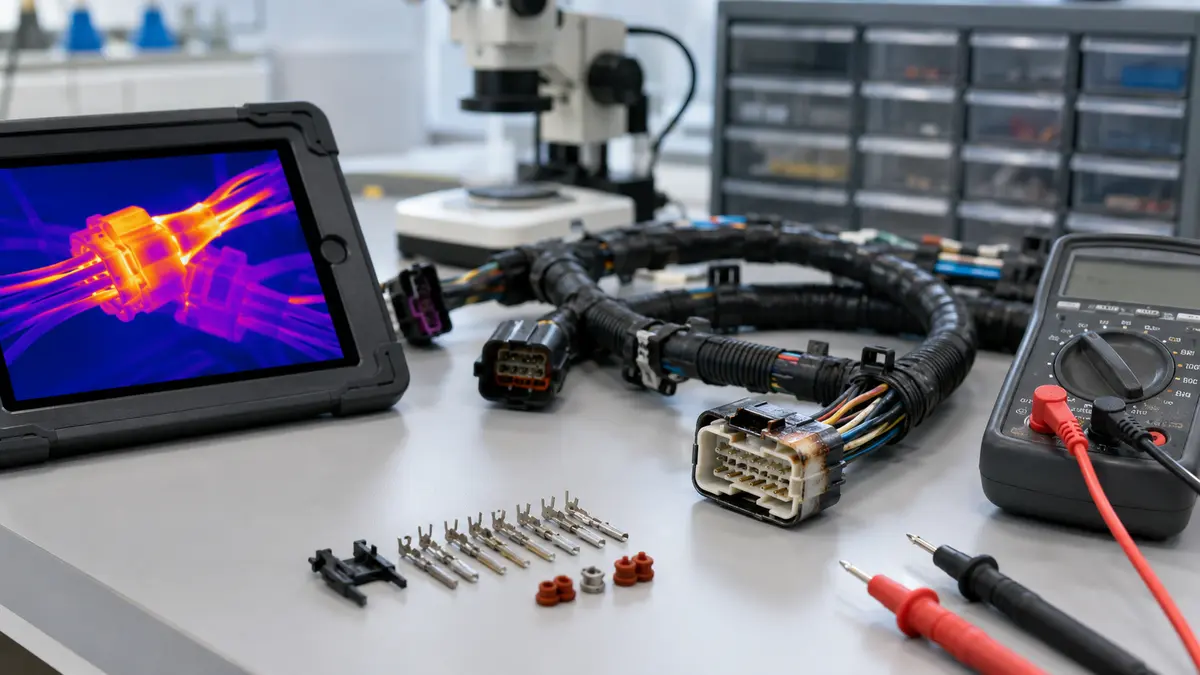
This guide avoids fixed current, voltage, temperature, IP, or service-life numbers because those values must come from the project drawing, component datasheet, test plan, and supplier documentation. Treat each parameter below as a review item to confirm before sourcing or rebuilding the harness.
Start With the Failure Mode, Not the Burn Mark
The visible burn area is only the evidence. The root cause may be upstream in the mating connector, downstream in the load, or hidden in the way the harness was routed. A buyer who replaces only the charred connector can miss the condition that will damage the next harness.
In most connector-related heat events, the first technical check is contact resistance. A terminal that no longer maintains firm contact can create localized heating under load. Corrosion, fretting, worn plating, poor crimp geometry, incomplete terminal insertion, and latch movement can all reduce the effective contact area. The engineering decision is simple: if the contact interface changed during service, the replacement part alone is not the corrective action.
For mixed power and signal harnesses, do not wait for visible melting before investigating. Intermittent communication errors, nuisance faults, or unstable voltage readings can point to a connection that is already degrading. If the harness is part of a larger wire and connector system, it helps to review the basic harness function and routing logic first; LinkManu’s guide on what a wire harness is and how it works gives useful context for that review.
Check the Conditions That Push a Connector Toward Heat
A burnt wiring harness is rarely explained by one variable. The more useful review is a condition-by-condition check that asks where the connector lost margin.
- Load profile: Confirm continuous load, peak load, duty cycle, and how long the peak condition lasts. A harness that survives a short peak may still run hot if that condition becomes normal operation.
- Terminal retention: Inspect whether each terminal is fully seated and locked. A terminal that backs out slightly can still pass a quick continuity check while carrying current through a smaller contact patch.
- Crimp quality: Ask for crimp height, pull-force, and process-control records where available. A weak crimp can begin with acceptable visual appearance and still develop resistance under vibration or thermal cycling.
- Routing stress: Look for sharp bends, unsupported cable weight, tight tie points, or exits that pull on the connector body. Mechanical stress at the cable exit often becomes electrical risk at the terminal.
- Environmental exposure: Confirm moisture, dust, chemicals, washdown, and temperature conditions at the actual connector location. The enclosure rating of the whole machine does not automatically protect every connector interface.
- Mating and service pattern: Identify connectors that are frequently disconnected during maintenance. Repeated service can loosen retention, damage seals, or introduce contamination.
The inspection rule is strict: if the mating connector, adjacent insulation, or conductor strands show heat exposure, the review should include the full connection path. Heat can damage more than the part that looks worst in a photograph.
Selection Parameters to Confirm Before Rebuilding
Once the failure mode is understood, the next step is a controlled selection review. The goal is not to choose the largest connector available. The goal is to match electrical load, environment, routing, and assembly process with enough documented margin for the actual machine.
| Selection Area | What to Confirm | Why It Matters for a Burnt Wiring Harness |
|---|---|---|
| Current and duty cycle | Continuous load, peak load, start-up behavior, and operating time under load. | Heating risk depends on how the connector is used in the system, not only on a catalog rating. |
| Voltage and insulation system | Maximum operating voltage, transient exposure, insulation material, creepage needs, and clearance needs. | A heat-damaged connector can create leakage paths or weakened insulation that a simple continuity check may not catch. |
| Terminal and plating choice | Contact material, plating compatibility, mating part, corrosion exposure, and expected service pattern. | Wrong material pairing or worn contact surfaces can raise resistance before the housing shows damage. |
| Housing and seal design | Housing material, seal compression, cable entry sealing, and installation-zone exposure. | Moisture and contaminants often enter through the cable exit or damaged seal, not only through the front face. |
| Mechanical lock and routing | Latch type, secondary lock, strain relief, bend radius, and clamp position. | Vibration or cable pull can reduce contact pressure and start intermittent heating. |
| Manufacturing control | Crimp tooling, operator process, inspection records, sample approval, and traceability. | A repeatable assembly process reduces variation that may not be visible in a one-piece sample. |
For new projects, put these checks into the drawing review or RFQ package. For repair projects, compare the failed harness against the intended specification before approving a replacement. LinkManu’s article on electrical specifications for cable assembly and wiring harness projects can help organize the electrical part of that request.
Do Not Treat Repair and Redesign as the Same Job
Repair answers the immediate downtime problem. Redesign answers the recurrence problem. A field splice or connector swap may restore function, but it adds new termination points and may not match the original sealing, strain relief, or inspection control. If the equipment operates in vibration, moisture, or high-load conditions, a temporary repair should be documented and followed by an engineering review.
When reviewing a damaged harness, separate the work into three decisions. First, decide what must be replaced now to make the equipment safe to inspect. Second, decide what evidence must be kept: photos, load condition, connector position, mating part condition, and service history. Third, decide whether the next harness needs a different connector, routing change, strain-relief change, or supplier process requirement. Skipping the third step is how the same burnt wiring harness returns in the next batch.
Practical replacement rule: if heat damage is visible at the connector, also inspect the mating side, the conductor near the termination, and the cable exit. A harness that “tests okay” at no load may still fail when current, vibration, and heat are present together.
Supplier Review Should Cover Process, Not Only Part Number
A harness supplier should be evaluated by how it controls the operations that affect contact resistance and mechanical retention. The uploaded LinkManu facts support assembly, injection molding, stamping, tooling, IATF 16949, and ISO 14001 references. Those facts matter because burnt harness prevention depends on repeatable parts and repeatable process, not only on a selected connector family.
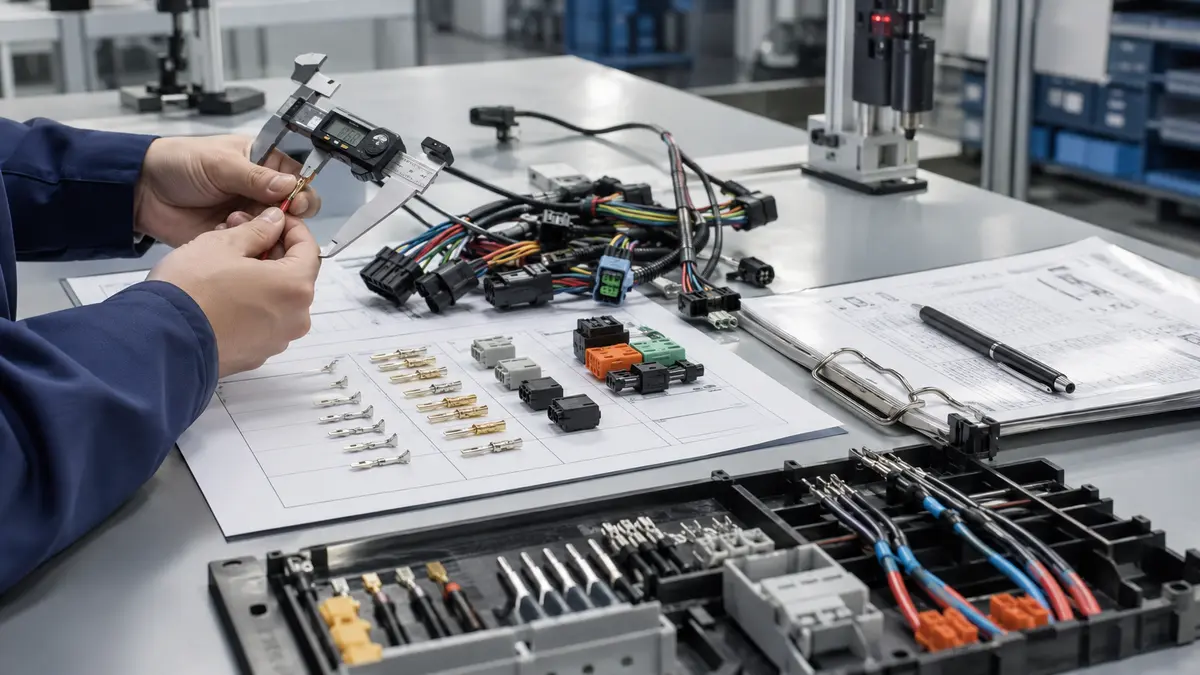
For sourcing teams, the supplier questions should be direct. Can the supplier review the drawing and BOM before production? Can it confirm the mating connector and terminal system? Can it provide inspection records for crimping and terminal insertion? Can it trace material lots and process steps if a field issue appears? Can it support connector-related tooling, molding, stamping, and assembly under one quality workflow?
LinkManu’s Custom Cable Assemblies & Wire Harnesses Manufacturer capability is relevant when the project needs harness assembly review together with connector, molding, stamping, and tooling considerations. For nonstandard connector work, early discussion with custom connector engineering can also clarify whether the risk is in the harness, the connector interface, or the installation environment.
What to Send for an Engineering Review
A useful review package should let the supplier reproduce the decision environment. Do not send only a photo of the burnt area and ask for the same part. Send the information that explains how the harness was expected to work.
- Drawing, harness layout, connector part references, and mating-side information.
- BOM, wire specification, insulation requirement, terminal and housing details, and any existing test documentation.
- Continuous load, peak load, duty cycle, and fault history from the machine or device.
- Installation environment: moisture, dust, chemical exposure, vibration, service access, and cable movement.
- Photos of the damaged harness, mating connector, routing path, clamp locations, and surrounding components.
- Required documentation for sampling, incoming inspection, production approval, and field containment.
The next step is specific: confirm the drawing, connector family, terminal system, wire gauge, current rating, voltage environment, routing constraints, sealing requirement, mating cycle expectation, and supplier documentation before ordering the replacement or approving the next build. If those details are not settled, request an engineering review before production. Get Engineering Review
FAQ About Burnt Wiring Harness Projects
What causes a burnt wiring harness?
The usual cause is heat at a weak electrical connection. Check loose terminals, corrosion, poor crimp quality, overload conditions, damaged seals, and routing stress before approving a replacement.
Can I replace only the burnt connector?
Only after the mating connector, conductor near the termination, insulation, and load condition have been checked. If heat traveled into the wire or mating side, replace more than the visible connector.
What information should I send to a harness supplier?
Send the drawing, BOM, connector references, mating part, load profile, installation environment, photos of the damaged area, and any test or service records.
When is a custom harness review needed?
Request review when the harness carries significant load, faces vibration or moisture, uses nonstandard routing, has frequent service disconnection, or has already shown heat damage.
Send Your Connector Requirement
Submit your drawing, bill of materials, target application context, or technical specifications. LinkManu can review connector compatibility, sampling feasibility, documentation needs, and RFQ readiness before final selection.

Prepared by LinkManu Editorial Team for B2B connector engineers, sourcing teams, and product development projects. Updated 2026.