
Industrial Connector Selection Guide
M12 Connector Types for Industrial Applications
Selecting an M12 connector starts with the function the interface must carry, but it cannot stop there. Coding, pin assignment, gender, orientation, termination, shielding, cable construction, and mounting style all affect whether two parts will mate and whether the finished assembly will suit the machine.
For engineers and technical buyers, the useful question is not simply “Which M12 series should we buy?” It is “Which combination of coding and construction matches the drawing, the mating part, the installation space, the electrical function, and the verification documents required before approval?” This guide reviews m12 connector types from that procurement and RFQ perspective.
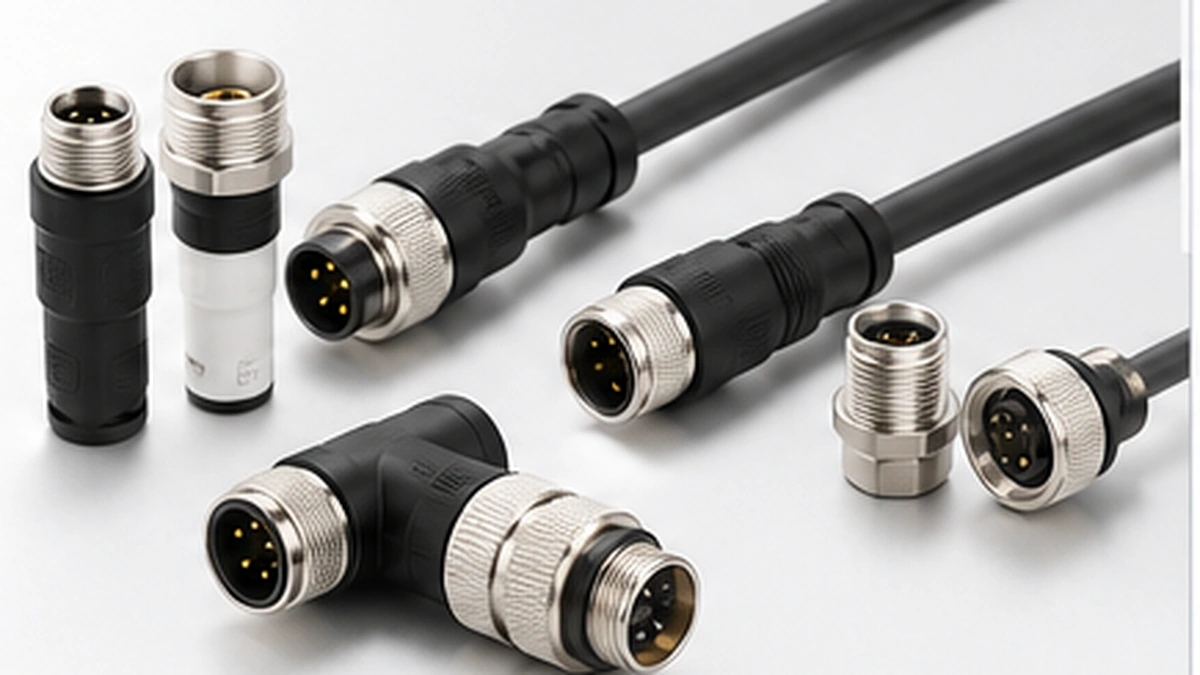
Start With the Function, Not the Connector Shell
Two connectors may share the same general circular format and still be unsuitable for each other. The coding can differ, the contact layout can differ, and the electrical purpose can differ. A dimensional drawing may confirm that the connector fits the available envelope, but it does not establish the pinout, shielding method, cable construction, or permitted electrical load.
Before comparing suppliers, identify the interface function in the equipment:
- Sensor, actuator, or general I/O: confirm every signal assignment, ground or shield connection, and any reserved contacts. A familiar coding does not prove that the customer pinout is the same.
- Plant network or fieldbus: confirm the protocol used by the installed equipment and the termination required by that network. Replacing a connector by appearance alone can create a wiring or communication mismatch.
- Industrial data: review the complete channel, including the connector at both ends, cable category, shielding continuity, and routing. The connector code by itself is not a data-performance guarantee.
- Power: obtain the rated current, rated voltage, protective-conductor arrangement, and thermal limits from the selected part drawing or datasheet. Do not infer them from a coding letter.
Engineering check: place the customer pinout and the proposed supplier pinout side by side. Verify contact numbering, viewing direction, male or female side, key orientation, and shield or protective-conductor treatment before samples are ordered.
For a broader view of connector decisions in machinery, see Industrial Equipment Connector Solutions. That application context should be used once the actual machine function and installation conditions are known.
Common M12 Coding Groups and the Checks They Trigger
M12 coding provides a keyed mating arrangement and is commonly associated with different signal, network, data, or power uses. The associations below are useful for narrowing the search, but they are not substitutes for the selected manufacturer’s drawing and technical documentation.
| Coding Group | Common Selection Intent | What Must Be Confirmed Before Approval | Typical Procurement Risk |
|---|---|---|---|
| A-coded | Sensor, actuator, and general I/O connections | Pin assignment, contact count, mating gender, key orientation, and shielding requirement | Assuming that an existing machine pinout follows the supplier’s standard arrangement |
| B-coded | Fieldbus or legacy plant-network interfaces | Installed network, cable and termination requirements, pinout, and availability for future maintenance | Buying a mechanically similar part that does not match the installed network interface |
| D-coded | Industrial data connections | Protocol, data requirement, shielding, cable construction, termination, and documentation for the complete link | Treating the coding as proof of channel performance without checking the cable assembly |
| X-coded | Higher-bandwidth industrial data links | Channel architecture, shield continuity, cable routing, termination, and compatibility at both ends | Reviewing the connector but not the cable, bend path, or grounding design |
| C-coded | Power or control connections used in some equipment | Customer pinout, AC or DC duty, protective-conductor arrangement, ratings, and mating key | Carrying a general coding association into a specific machine without drawing confirmation |
| L-, K-, or S-coded | Power-oriented M12 families | System type, rated current and voltage, pin arrangement, derating conditions, cable size, and mating interface | Ordering by coding alone and overlooking a different power architecture or thermal condition |
Procurement should treat the coding as a classification field in the RFQ, not as the complete specification. The part number, revision-controlled drawing, mating connector, and application limits remain the controlling documents.
Connector Type Also Includes Construction and Installation
Coding receives most of the attention, but construction choices often decide whether the connector can actually be installed, assembled, and serviced. The following variants should be reviewed on the same drawing set as the coding and pinout.
Cable Plug, Panel Receptacle, or PCB-Mount Interface
A cable plug must match the cable diameter, conductor construction, termination method, and strain-relief design. A panel receptacle adds panel cutout, mounting side, sealing hardware, nut access, and internal wiring clearance. A PCB-mounted version adds board layout, soldering process, mechanical support, and enclosure tolerance. The risk is approving the electrical interface before confirming that the selected mounting form fits the assembly process.
Straight or Right-Angle Cable Exit
A right-angle exit can reduce the required depth, but it also fixes the cable direction and may restrict wrench access or service removal. A straight exit is easier to route in some cabinets but may place the cable bend directly in front of a door, guard, or moving assembly. Check the connector body, coupling access, cable bend path, and nearby components in the installed position—not only in an isolated CAD view.
Molded Assembly or Field-Wireable Connector
A molded cable assembly reduces field termination steps, while a field-wireable design can simplify installation or replacement where cable routing is completed on site. The field-wireable option adds workmanship variables: conductor preparation, shield handling, termination method, sealing, and assembly torque. The RFQ should state who performs the termination and what inspection evidence is expected.
Shielded or Unshielded Construction
Shielding must be reviewed as a system path. A shielded connector does not correct a cable, enclosure, or grounding design that breaks continuity elsewhere. For data or noise-sensitive signals, request the connector and cable construction details and confirm how the shield is terminated at both ends. For other circuits, do not add shielding automatically without considering grounding and installation practice.

Use a Drawing-Level Review Before Samples or Tooling
A supplier can only flag a mismatch when the RFQ contains enough information to compare the proposed connector against the equipment. A part number alone is weak input, especially when it refers to an obsolete item, a customer-specific variation, or a cable assembly with undocumented pin assignments.
The engineering review should cover five groups of evidence:
- Electrical function: signal names, power and ground assignments, shield treatment, required ratings, and any protocol or channel requirement.
- Mating definition: mating part number or drawing, gender, coding, key orientation, contact numbering view, and mechanical locking interface.
- Mechanical installation: panel cutout, mounting direction, available depth, cable exit, coupling access, nearby obstructions, and service-removal path.
- Cable and termination: cable length, conductor and insulation details, overall diameter, jacket material, shielding, overmold or field termination, and strain-relief requirement.
- Environment and validation: vibration, washdown or chemical exposure, humidity, temperature conditions, mating frequency, and the drawings or test records required for approval.
Approval rule: do not accept “standard M12” as the final description on the BOM. Record the coding, construction, pinout revision, mating part, cable specification, required ratings, and supplier document revision.
Where testing is required, define the acceptance criteria before the supplier proposes a test plan. Insertion and extraction force, temperature rise, dielectric testing, impedance-related checks, salt-spray exposure, or other environmental tests may be relevant, but the scope must follow the application and agreed documentation. A generic test list does not prove that a connector is suitable for the project.
Prepare an RFQ That Allows a Supplier to Find Problems
A useful M12 RFQ should make the supplier review the design, not merely quote the closest catalog description. Include the following items when available:
- Connector, cable-assembly, panel, or enclosure drawing with revision status
- Pinout showing signal names, ground, shield, and protective-conductor assignments
- Mating connector part number, drawing, or controlled sample
- Installation photos or CAD views showing cable exit and maintenance access
- Application environment and the required rating or test documents
- Cable length, jacket, shielding, conductor, and termination requirements
- Initial sample quantity, expected production volume, and inspection expectations
- Any requested customization, including overmold, cable exit, key orientation, housing, insert, or terminal changes
This package gives the supplier enough context to identify whether the request is a standard part match, a cable-assembly configuration, or a custom development review. It also makes quotation differences easier to compare because each supplier is responding to the same controlled inputs.
How LinkManu Can Review an M12 Connector Inquiry
LinkManu’s available manufacturing capability references include assembly, injection molding, stamping, and tooling. For an M12 inquiry, those capabilities are relevant when the scope extends beyond purchasing a catalog component and requires review of a housing, insert, terminal, overmold, or finished cable assembly. Feasibility, tooling scope, ratings, and testing still need to be confirmed for the specific project.
Project-dependent engineering support may include Pro-E modeling, Moldflow analysis, terminal stress analysis, or signal-integrity simulation. Not every connector requires each step. The RFQ should first establish the unresolved risk: physical fit, molding behavior, terminal mechanics, data-channel performance, or another defined concern. More information is available on the Engineering & Quality page.
Quality documentation and testing can be arranged according to the connector type and acceptance plan, with some work performed in-house and specialized testing outsourced when required. Buyers should ask who performs each test, which revision of the drawing is tested, what sample configuration is used, and what report will be delivered.
For requests involving changed housings, cable assemblies, keying, or other non-standard features, the Custom Connector Support page explains the drawing-to-review process. The Connector Products page can also help identify a starting category, but the final M12 selection should still be resolved through the project drawing and mating definition.
Next Step: Lock the Specification Before Quotation
Before requesting a final quotation, confirm the connector coding, pin assignment, mating part, gender, mounting form, cable exit, cable construction, shielding approach, required ratings, environment, and acceptance documents. Mark any unresolved item as an RFQ question rather than allowing the supplier to assume it.
Send the controlled drawing, pinout, application conditions, cable requirements, and expected sample or production quantities through Contact LinkManu. The review can then focus on mismatches, documentation gaps, sample scope, and the supplier capability required for the actual connector construction.
Frequently Asked Questions About M12 Connector Types
What are the main M12 connector types?
M12 types are commonly separated by coding and by construction. Confirm the coding, pinout, gender, mounting style, orientation, termination, shielding, cable, and mating part for the exact application.
Can two M12 connectors mate because they use the same shell size?
No assumption should be made from the shell alone. Check coding, key orientation, gender, insert layout, locking interface, and the mating drawing.
Is pin count enough to select an M12 connector?
No. The same contact count can appear in different coding, pinout, shielding, mounting, and cable configurations.
Which ratings should be confirmed before ordering?
Confirm the required current, voltage, environmental protection, temperature limits, and any data or test requirements from the exact part documentation and project specification.
What should be sent to a supplier for an M12 review?
Send the connector and mating drawings, pinout, cable requirements, installation conditions, environment, required documents, quantities, and any requested customization.
Can LinkManu evaluate a custom M12 connector requirement?
LinkManu can review whether the requirement fits the available assembly, molding, stamping, tooling, and project-dependent engineering scope. Feasibility and testing are confirmed during RFQ.
Send Your Connector Requirement
Share the drawing, pinout, mating definition, cable requirements, application environment, quantities, and required documentation for an engineering and RFQ review.

Technical content reviewed by LinkManu Engineering Team
Prepared by LinkManu Editorial Team for B2B connector engineers, sourcing teams, and product development projects.