
Connector Engineering Resources
How to Put Connector on Coax for I/O Projects
Most searches for “how to put connector on coax” lead to a home cable tutorial. That can be useful for learning the basic sequence, but it is not enough for an I/O panel, test fixture, industrial controller, or custom cable assembly. In those projects, the question is not only how to strip the cable. The buyer also has to confirm whether the connector, cable prep, panel interface, tooling, and inspection plan can be repeated without creating signal or shielding problems.
Start With the Project Risk, Not the Tool
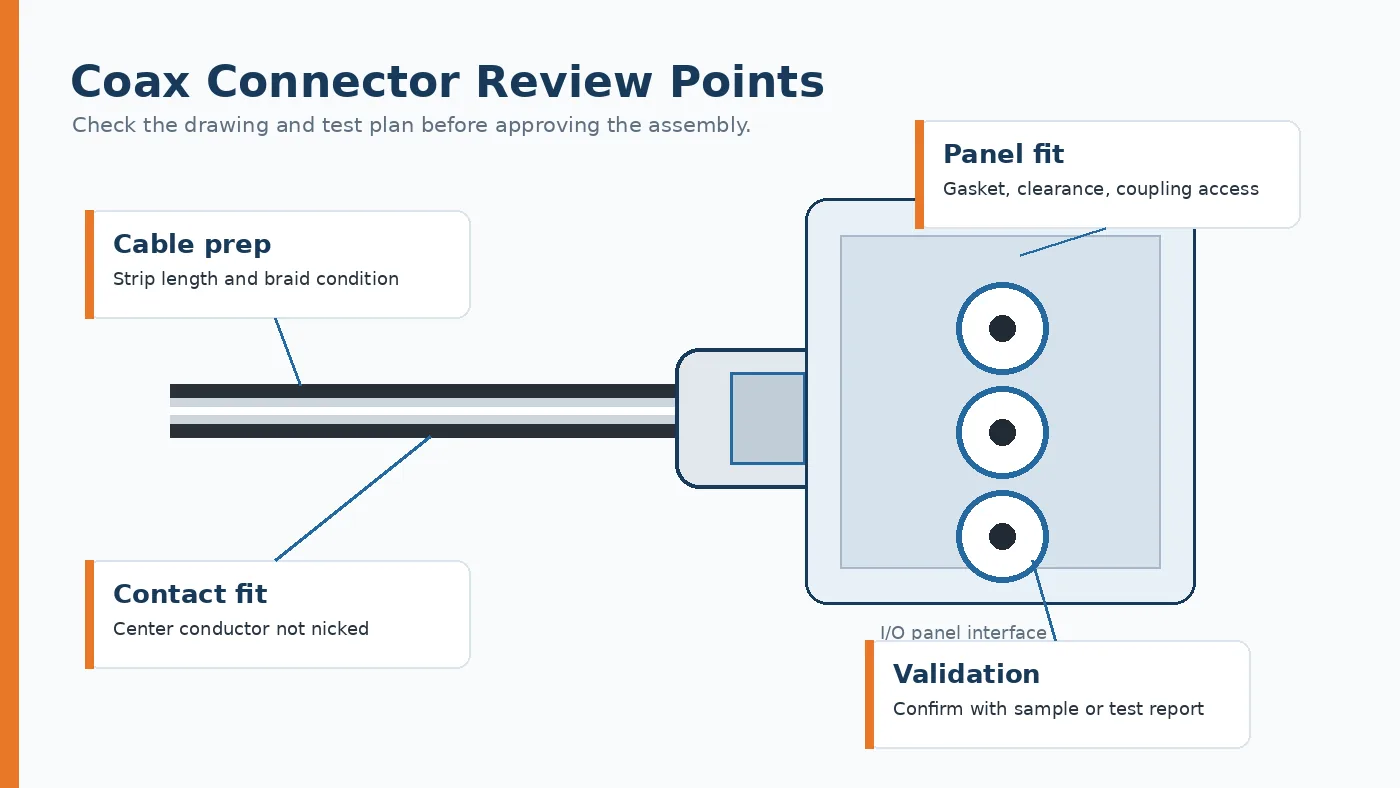
A generic coax installation guide usually starts with a stripper and a crimp tool. For an OEM project, start one step earlier. Ask where the assembly will sit, how often it will be handled, whether it passes through a sealed panel, and what signal behavior must be protected. A connector that looks acceptable on a bench can still become a weak point after repeated handling, vibration, poor cable routing, or an enclosure change.
The practical judgment is simple: if the coax line is part of a product interface, do not approve it only from a finished photo. Require the drawing, cable type, connector family, panel cutout, termination instruction, and sample inspection plan. If any one of those is missing, the sourcing decision is still incomplete.
Engineering check: treat impedance, sealing, temperature, insertion force, mating cycles, plating, and material requirements as project-specific values. Confirm them from the customer drawing, connector datasheet, sample test report, or validation plan before they appear in a purchase specification.
What Changes When Coax Enters an I/O Panel
Coax termination is sensitive because the connector, dielectric, center contact, shield, and outer body all form part of the signal path. A rough braid trim, damaged center conductor, loose ferrule, or poorly supported cable exit can create failures that do not show up during a quick continuity check. For I/O projects, the connector also has to live with the mechanical design of the panel: gasket thickness, nut access, bend radius, operator clearance, and nearby USB, RJ45, power, or signal connectors.
That is why the article angle here is not “buy this connector and crimp it.” It is a procurement checklist. For mixed interface panels, review the coax port together with the rest of the I/O connector family, because one connector can pass its own drawing and still fail the assembly if the panel stack-up leaves no room for tightening, routing, or inspection.
RFQ Checklist Before Putting a Connector on Coax
Before requesting price or samples, build the RFQ around the information that affects repeatability. If a supplier can only quote from a cable diameter and a connector name, the quote may be fast, but the risk is still sitting in your engineering team.
| RFQ Item | What to Confirm | Why It Matters |
|---|---|---|
| Connector family | Series, gender, coupling style, mounting method, and mating interface. | A similar-looking coax connector may not mate, lock, or fit the panel as expected. |
| Cable construction | Outer diameter, dielectric, braid or shield structure, jacket, and bend limits from the cable spec. | The strip length, ferrule fit, and strain relief depend on the actual cable, not only the connector name. |
| Electrical target | Impedance, frequency range, return-loss target, or other signal requirements from the validation plan. | These values should be confirmed as project requirements, not copied from a general web guide. |
| Panel condition | Cutout drawing, gasket or seal requirement, mounting thickness, and tool access. | A correct cable assembly can still be rejected if the connector cannot be installed cleanly in the housing. |
| Assembly method | Crimp, solder, clamp, overmold, or other termination process required by the connector design. | Each method needs different tooling, operator control, and inspection criteria. |
| Inspection evidence | Visual criteria, fit check, electrical check, pull or strain review, and any project-specific test records. | The buyer needs evidence that the sample can become a repeatable production assembly. |
When Field Termination Is Too Risky
Field termination can make sense for a quick lab cable or a one-off prototype, but it becomes risky when the same assembly must be built many times. The hidden cost is not only the connector. It is the stripped cable that varies by operator, the die set that was not matched to the connector, the rework that delays a build, and the failure report that comes back as “no fault found” because the defect appears only after handling or environmental stress.
A useful procurement rule is to separate “can we physically attach it?” from “can we prove the process is stable?” If the project needs repeatable samples, documented inspection, or consistent panel fit, factory-integrated coax assemblies are usually easier to control than hand-built field terminations. LinkManu-related source materials support assembly, tooling, injection molding, stamping, design engineering, mold development, post-processing, and inspection before shipment. The exact process still depends on the product type and RFQ scope, so the buyer should ask which steps apply to this assembly instead of assuming every process is used on every project.
Connector Family Choice Needs a Boundary Condition
Names such as SMA, BNC, TNC, SMB, or micro-coax families are only starting points. The right choice depends on the boundary condition: panel space, coupling method, operator access, cable size, signal requirement, vibration exposure, and whether the connector sits inside the enclosure or on an external interface. A push-on style that is convenient inside a housing may need a secondary lock or routing support if the assembly will be handled. A threaded style may improve retention, but it also needs enough tool clearance and a defined torque process.
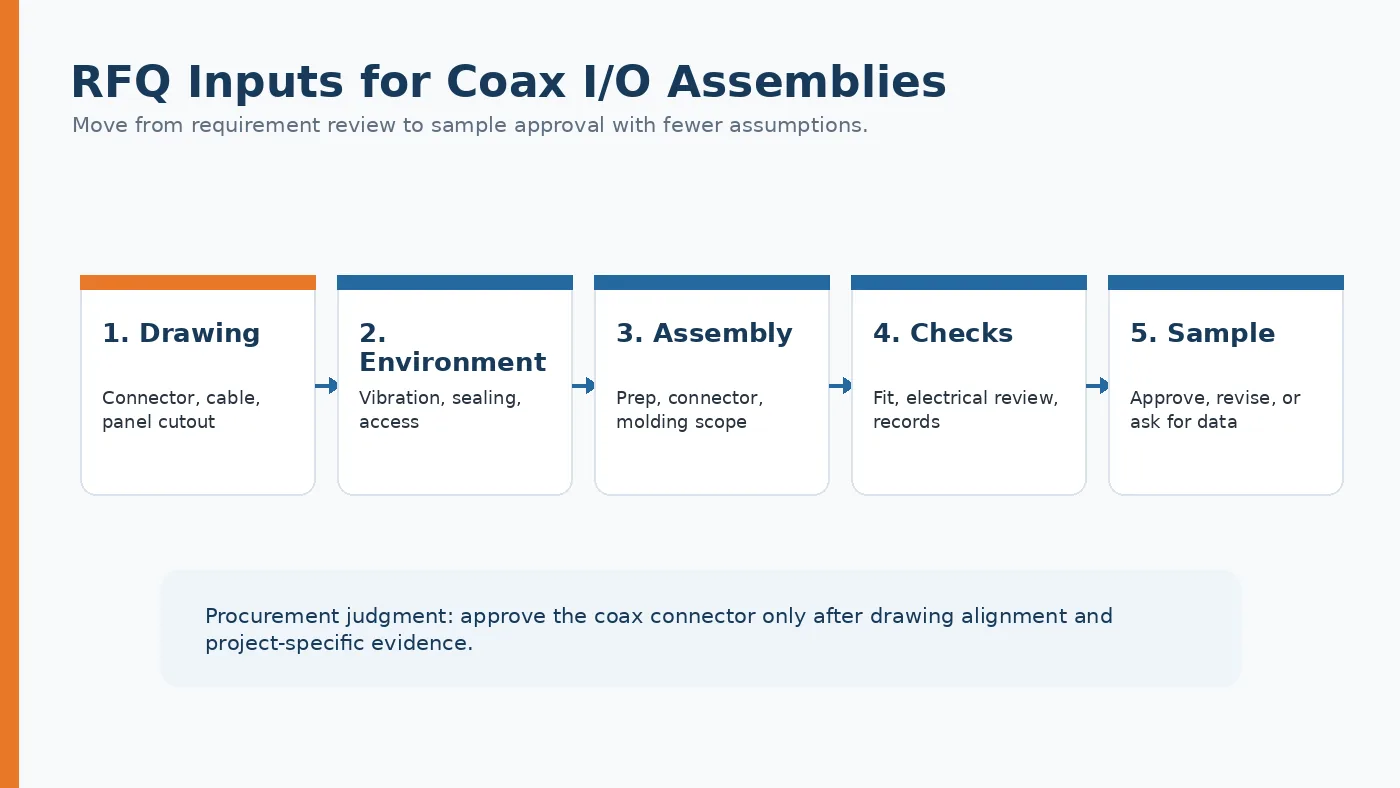
For procurement, the safer request is not “quote a coax connector.” Ask for a mated proposal that includes connector series, cable compatibility, drawing review, assembly method, inspection method, and any items that must be confirmed by the customer. This keeps the supplier from filling gaps with assumptions and gives the engineering team a cleaner basis for approval.
Supplier Questions That Prevent Late Rework
Use these questions before sample approval, especially when the design has a panel interface or mixed I/O layout.
- Which drawing controls the connector interface, panel cutout, cable exit direction, and mating clearance?
- Which cable construction is being used, and has the supplier checked the connector fit against that exact cable?
- Which termination instruction, die set, soldering condition, or molding process will be used for samples and production?
- Which project values still need customer confirmation, such as impedance target, environmental exposure, material, plating, or test documentation?
- What inspection records can be supplied with samples, and which tests are in-house, outsourced, or project-dependent?
- If the coax port sits beside other I/O connectors, has the full panel spacing and tool access been reviewed?
Practical Next Step
To move from a search for how to put connector on coax to a usable OEM decision, prepare a small RFQ package: connector drawing, cable specification, panel drawing, target environment, signal requirement, sample quantity, and documentation needs. If any requirement is still unknown, mark it as a confirmation item instead of letting it become an implied promise. That gives the supplier a cleaner path to review fit, propose an assembly method, and identify what must be tested before release.
FAQ
Can an OEM use a consumer guide to put connector on coax?
Only for basic orientation. For an I/O product, the connector must be checked against the drawing, cable construction, panel fit, and validation plan.
What is the first item to confirm before sample approval?
Confirm the connector and cable are matched by drawing and termination instruction. A visual match is not enough.
Should coax termination be done in-house?
It can be done for prototypes if the tools and inspection method are controlled. For repeat production, factory assembly is usually easier to document and repeat.
What should be sent with a coax connector RFQ?
Send the connector drawing, cable spec, panel drawing, target environment, signal requirement, sample quantity, and required test documentation.
Send Your Connector Requirement
Share your drawing, cable details, panel condition, target application, and documentation needs. LinkManu can review connector fit, sample options, inspection requirements, and RFQ readiness before final selection.

This article is written for connector sourcing and engineering review. Project-specific ratings, materials, and test plans should be confirmed from drawings, samples, datasheets, or agreed validation documents.