
Automotive Connector Selection Guide
Evaluating Automotive Electrical Connector Manufacturers
Choosing among automotive electrical connector manufacturers is not the same as finding a housing that appears to fit. A sourcing decision also fixes who will control the tooling, terminal geometry, molding conditions, assembly checks, documentation, and later engineering changes. Those controls matter when a connector is exposed to vibration, temperature change, moisture, fluids, repeated mating, or tight packaging constraints.
The practical starting point is simple: separate confirmed project inputs from assumptions. The drawing, mating interface, mounting location, circuit requirements, harness or PCB context, and validation plan should be clear before suppliers are compared. A supplier that asks precise questions may be slower to quote, but that behavior is usually more useful than a fast price based on missing data.
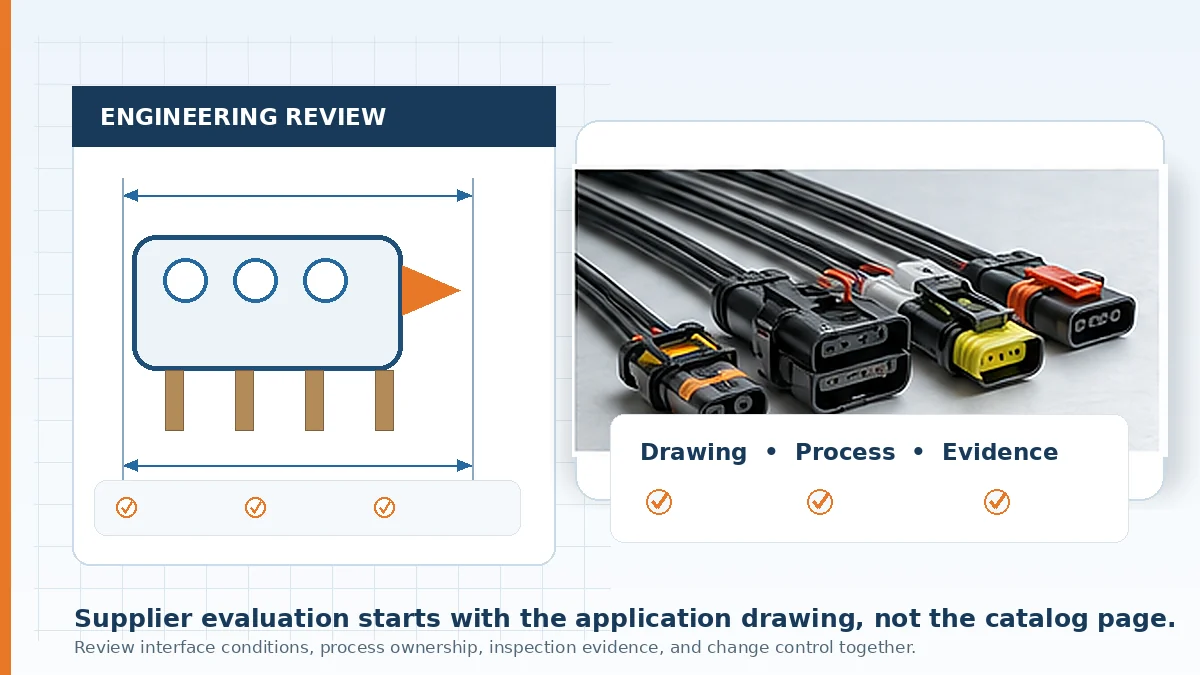
Evaluate the Manufacturer, Not Only the Sample
A visually acceptable sample proves very little about production stability. It may confirm the mating shape and basic assembly, but it does not show whether terminal spring geometry is controlled across batches, whether resin changes are documented, or whether a tooling correction can be traced to the approved revision.
For procurement teams, the first risk check is to ask who owns each production step. Current LinkManu source materials list tooling, stamping, injection molding, and assembly capabilities. That does not mean every project uses every process in-house, so the RFQ should still identify which operations apply to the requested connector and which inspections or tests may be handled by an external laboratory.
Engineering check: Do not approve a manufacturer from one catalog page or one hand-built sample. Ask for the production route, process ownership, drawing revision, sample status, and the evidence available for the exact part under review.
Start with Application Inputs Before Comparing Suppliers
Manufacturers cannot select a reliable connector architecture from a part name alone. The following inputs should be controlled before quotation. Missing items should be listed as open questions rather than filled with supplier assumptions.
| Input to Confirm | Why It Changes the Selection | Evidence to Attach or Request |
|---|---|---|
| Mounting location and environment | Cabin, chassis, enclosure, and exposed locations create different sealing, retention, material, and validation questions. | Application description, mounting drawing, exposure list, and the customer validation plan. |
| Electrical and signal architecture | Power, low-level signals, and high-speed links require different terminal, spacing, shielding, and layout reviews. | Circuit map, current-by-contact requirement, interface definition, and PCB or harness context. |
| Mating and mechanical interface | Housing envelope, keying, latch design, terminal retention, and lock access determine whether the part can be assembled and serviced. | Controlled 2D/3D drawing, mating-part information, available samples, and allowable assembly direction. |
| Production and service conditions | Volume, packaging, traceability, repair method, and change timing affect tooling and quality planning. | Forecast range, packaging request, labeling rules, service expectations, and change-notification needs. |
The broader system context also matters. The Automotive Electronics Connector Solutions page provides the approved topic-cluster context for module, PCB, and cable-interface projects. Use it to frame the application, then return to the part-specific drawing for the actual selection decision.
Review Process Control and Engineering Support
Manufacturing scope is useful only when it is tied to the connector under review. A factory may have tooling, stamping, molding, and assembly capability, but the buyer still needs to know where the proposed terminal tool will be built, who controls mold changes, how critical dimensions are monitored, and how incomplete assembly or terminal insertion is detected.
- Tooling: confirm ownership, maintenance responsibility, revision control, and the route for approving a tool correction.
- Stamping: ask which terminal dimensions are treated as critical and how coil, material, or die changes are recorded.
- Injection molding: request the approved resin callout, cavity identification method, dimensional inspection plan, and handling of material substitutions.
- Assembly: review terminal insertion checks, secondary-lock verification, orientation controls, and how nonconforming units are segregated.
- Inspection and testing: separate routine production checks from project-specific validation, and identify any work performed by a third party.
Project-dependent engineering support may include 3D modeling, mold-flow review, terminal stress analysis, or signal-integrity simulation. These services should not be assumed for every quotation. Ask which review is relevant, what input files are required, and what deliverable will be returned. LinkManu’s Engineering & Quality overview can help buyers prepare these questions before an RFQ.
Material, Plating, Sealing, and Locking Need Drawing-Level Confirmation
Material tables can help frame questions, but they should not be used as a shortcut to a final callout. Industry references may show different housing resins, copper-alloy contact materials, plating systems, and seal materials. The correct combination depends on the drawing, load, mating behavior, environment, and validation plan.
| Design Area | Engineering Trade-off | What the Supplier Should Confirm |
|---|---|---|
| Housing resin | Strength, dimensional stability, molding behavior, and environmental resistance must be balanced. | Exact grade, approved source, processing controls, and suitability for the customer-defined condition. |
| Terminal base material | Conductivity and spring retention must be considered together; a nominal alloy name is not enough. | Material specification, temper, critical terminal geometry, and the inspection method. |
| Plating system | Low-level signal stability, wear, corrosion exposure, and cost can point to different choices. | Plating specification, controlled area, supplier evidence, and compatibility with the mating contact. |
| Seal and lock design | More retention or sealing can increase connector size, mating force, assembly steps, or service difficulty. | Seal material, latch and secondary-lock operation, access clearance, and validation method. |
| Termination method | Crimp, solder, press-fit, and other interfaces require different tooling and process controls. | Applicable termination route, tooling responsibility, acceptance criteria, and sample preparation. |
Risk point: A familiar material name or generic ingress-protection label does not prove suitability for the vehicle-level condition. Confirm the exact drawing callout and the test method that the customer will use.
Prepare an RFQ That Produces Comparable Answers
A useful RFQ gives every supplier the same controlled inputs. Without that discipline, one quotation may include tooling and validation work while another covers only a catalog part, making the price comparison misleading.
Documents to Attach
- A controlled drawing with critical dimensions, tolerances, mating details, and revision status.
- A system diagram or BOM context showing whether the connector is mounted to a PCB, cable, harness, or module.
- An application note covering mounting location, environmental exposure, assembly constraints, and required customer tests.
- Forecast, packaging, labeling, traceability, and sample-quantity expectations.
- Any existing mating sample, failure observation, or interface-control document that the supplier is allowed to review.
Questions to Ask Every Shortlisted Manufacturer
| Question | Procurement or Engineering Reason |
|---|---|
| Which operations for this part are performed in-house, and which are outsourced? | Clarifies accountability, lead-time risk, and where process changes must be controlled. |
| What evidence will accompany the first samples? | Prevents a visual-fit sample from being mistaken for a qualified production submission. |
| How are tooling, material, and process changes communicated after approval? | Tests whether the supplier can protect the approved configuration through the program lifecycle. |
| Which dimensions, insertion features, locks, and sealing interfaces are treated as critical? | Shows whether the supplier has translated the drawing into a practical control plan. |
| Which validation activities are available, and what requires an external laboratory? | Separates confirmed capability from assumptions and helps the buyer plan schedule and evidence needs. |
For a new interface or a part that requires geometry changes, use the same checklist when requesting Custom Connector Support. The first review should determine feasibility, missing inputs, ownership of design decisions, sample scope, and the evidence needed before tooling approval.
Control Samples, Approval, and Later Changes
Samples should be labeled by status. A rapid prototype, an off-tool sample, and a production-intent sample answer different questions. Ask the manufacturer to state the process route, material status, cavity or tool source, inspection performed, and any differences from the intended production configuration.
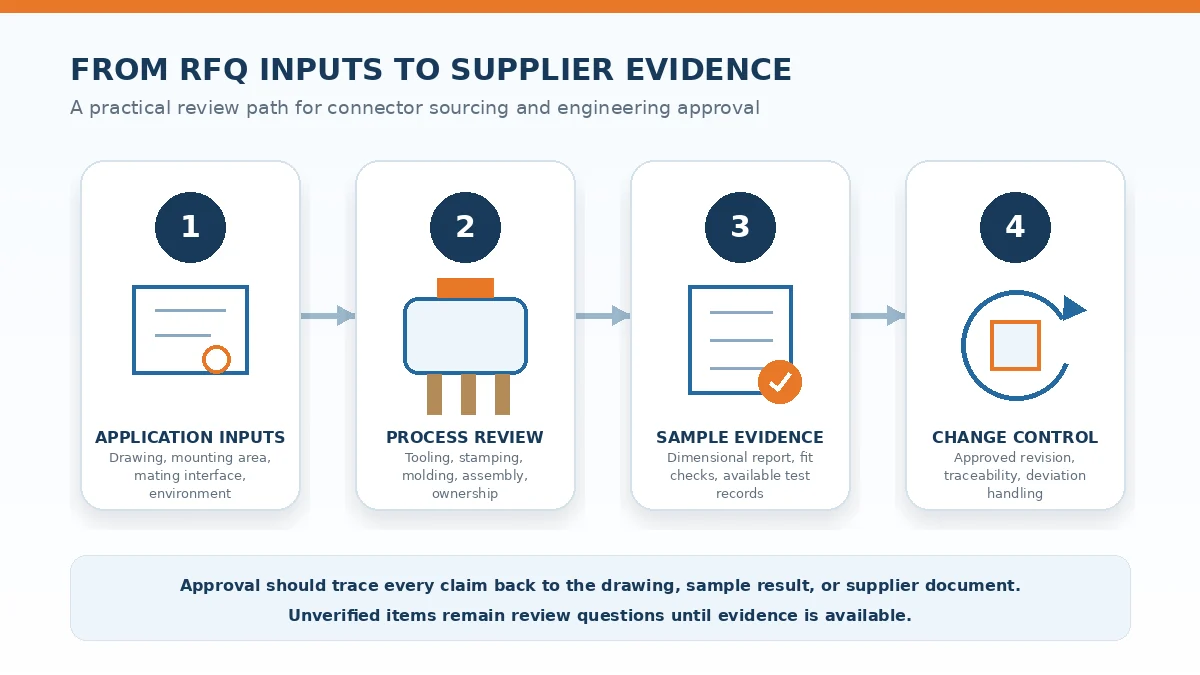
Before approval, compare the sample with the controlled drawing and the real mating part. Review the dimensional report, available material records, applicable test documentation, packaging, and traceability marking. Where a requirement is not yet verified, record it as an open item with an owner and closure evidence. Do not convert “planned,” “available,” or “can be arranged” into “passed.”
Change control is part of supplier selection, not an administrative detail after launch. The RFQ should define when the buyer must be notified about drawing revisions, tooling repairs, material-source changes, process relocation, or deviations. A technically capable manufacturer should be able to explain how the approved configuration will be protected and how exceptions will be reviewed.
Next Step: Build a Shortlist from Evidence
Do not rank automotive electrical connector manufacturers from unit price alone. Build the shortlist from five evidence groups: application fit, process ownership, drawing and material control, sample documentation, and change management. A low quotation with unclear scope should remain open until the missing work is identified.
The next action is to assemble the controlled drawing, mating information, circuit and environment requirements, sample expectations, required documentation, and supplier-capability questions. Send the same package to each shortlisted supplier. Where the interface or validation path is unclear, contact the LinkManu team for a pre-RFQ review rather than asking suppliers to quote from assumptions.
FAQ: Automotive Connector Manufacturer Selection
What should I verify before requesting a quote?
Confirm the drawing revision, mating interface, mounting location, circuit requirements, assembly method, environment, sample scope, and required documents.
Does a matching sample prove production compatibility?
No. It confirms only the checks actually performed. Ask for sample status, process route, dimensional evidence, and any differences from production intent.
Which supplier capabilities matter most?
Focus on the capabilities used for your part: tooling control, terminal stamping, molding, assembly, inspection, engineering review, documentation, and change management.
Should all testing be performed in-house?
Not necessarily. Ask what is performed internally, what is outsourced, which laboratory is used, and how results are linked to the approved part and revision.
Send Your Connector Requirement
Share the drawing, mating information, application conditions, sample needs, and required documentation. LinkManu can review RFQ completeness and identify questions that should be closed before supplier selection.

Technical content reviewed by LinkManu Engineering Team
Prepared by LinkManu Editorial Team for B2B connector engineers, sourcing teams, and product development projects.