
Industrial Connector Engineering
What Is the Current Rating of an M12 Connector?
There is no single current rating that can be assigned to every M12 connector. The number that belongs on a BOM must come from the exact connector configuration and the conditions in which it will operate. For an engineering or sourcing review, confirm the selected part or drawing, contact arrangement, conductor details, loading pattern, ambient conditions, and the supplier evidence that supports the rating.
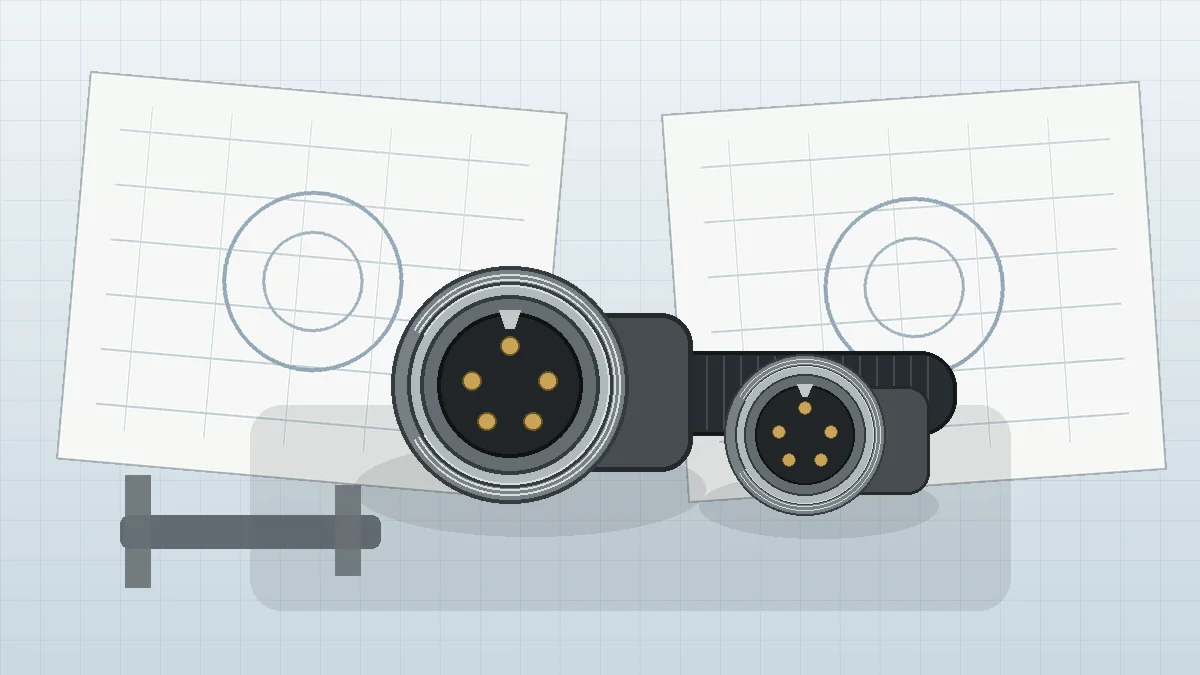
First approval question: does the current value you are using belong to this exact connector, contact arrangement, conductor, and operating condition? If the evidence cannot answer that question, keep the value open in the RFQ instead of treating it as confirmed.
Why the M12 Name Alone Does Not Establish Current Capacity
The M12 designation is a starting point for identifying an interface, not enough information to approve an electrical load. Different configurations can use different contact layouts, materials, conductor arrangements, and supplier qualification conditions. A current value copied from a different drawing may therefore be irrelevant to the part being sourced.
For procurement, the practical rule is simple: do not compare connectors only by family name. Compare the exact drawing and supplier documentation. If coding, pin arrangement, cable construction, or termination changes, ask the supplier to confirm that the current-rating evidence still applies to the selected configuration.
What Changes the Current-Rating Review
Current capacity becomes an application question when heat cannot leave the connector as it did under the supplier’s reference condition. A sealed enclosure, nearby heat source, tightly grouped connectors, continuous loading, or several loaded contacts can change the thermal condition that must be reviewed. These are not reasons to invent a new derating number; they are reasons to request the correct derating information or test evidence.
| Review Input | Engineering Question | Evidence to Request |
|---|---|---|
| Exact connector and contact arrangement | Does the stated current apply to the selected drawing and contact configuration? | Part-specific datasheet, drawing note, or supplier confirmation. |
| Conductor and termination | Is the wire, cable, PCB termination, or assembly construction included in the rating basis? | Assembly drawing and applicable conductor or termination specification. |
| Loaded contacts | How many contacts carry load at the same time in the real operating state? | Supplier derating guidance or project-specific thermal review. |
| Ambient and enclosure | Will the connector operate near heat sources, inside an enclosure, or with limited airflow? | Derating curve, application note, simulation output, or sample-test plan as applicable. |
| Duty cycle | Is the required load continuous, intermittent, or variable? | Load profile matched to the supplier’s stated rating conditions. |
Use a Drawing-to-Application Review Before BOM Approval
A useful review can be completed in three passes. First, lock the exact connector drawing and the mating arrangement. Second, map the real load profile and environment to the supplier’s rating basis. Third, record what evidence is required before purchasing releases the part. That sequence keeps engineering assumptions visible instead of burying them in a single “amps per pin” field.
1. Freeze the exact configuration
- Confirm part number or controlled drawing, contact arrangement, coding, mating interface, and termination style.
- Confirm the conductor or PCB connection used in the actual assembly.
- Check material and plating requirements against the customer drawing or supplier documentation rather than assuming they are common across the family.
2. Define the operating condition
- State the required current for each loaded circuit and identify which contacts can be loaded simultaneously.
- Record enclosure conditions, nearby heat sources, airflow limits, and the expected load cycle.
- If vibration, ingress, or maintenance access matters to the industrial equipment, keep those requirements in the same connector review so an electrical choice does not create a mechanical or service problem.
3. Close the evidence gap with the supplier
Ask for the document that supports the proposed rating under the relevant conditions. Depending on the project, that may be a part-specific datasheet, derating curve, design calculation, simulation output, or an agreed sample test. The exact standard, test method, limits, and acceptance criteria should come from the project documentation; they should not be inferred from a generic M12 description.
For a broader factory-equipment context, the Industrial Equipment Connector Solutions page can be used as the required topic-cluster reference. If a connector requires project-specific review, Engineering & Quality describes LinkManu’s engineering-support context. Which design, simulation, tooling, stamping, injection-molding, assembly, inspection, or test-related steps apply must be confirmed for the individual RFQ and product scope.
Example Review Condition: Same Family Name, Different Approval Question
Hypothetical engineering scenario: two proposed connectors are both described as M12, but one will be used in an open assembly and the other inside a compact enclosure with several loaded contacts. Even if the supplier literature looks similar, procurement should not assume the same allowable current. The second condition needs its own evidence check for simultaneous loading and thermal environment before the BOM is released.
The point of the example is not that one configuration must be derated by a fixed amount. The decision is whether the supplier’s stated current is supported for the exact application. If the answer is unclear, the correct purchasing status is pending confirmation.
Project-Ready M12 Current Rating Checklist
Use this checklist before approving a sample, purchase specification, or alternate source. Every line should resolve to a controlled document, supplier response, or test plan.
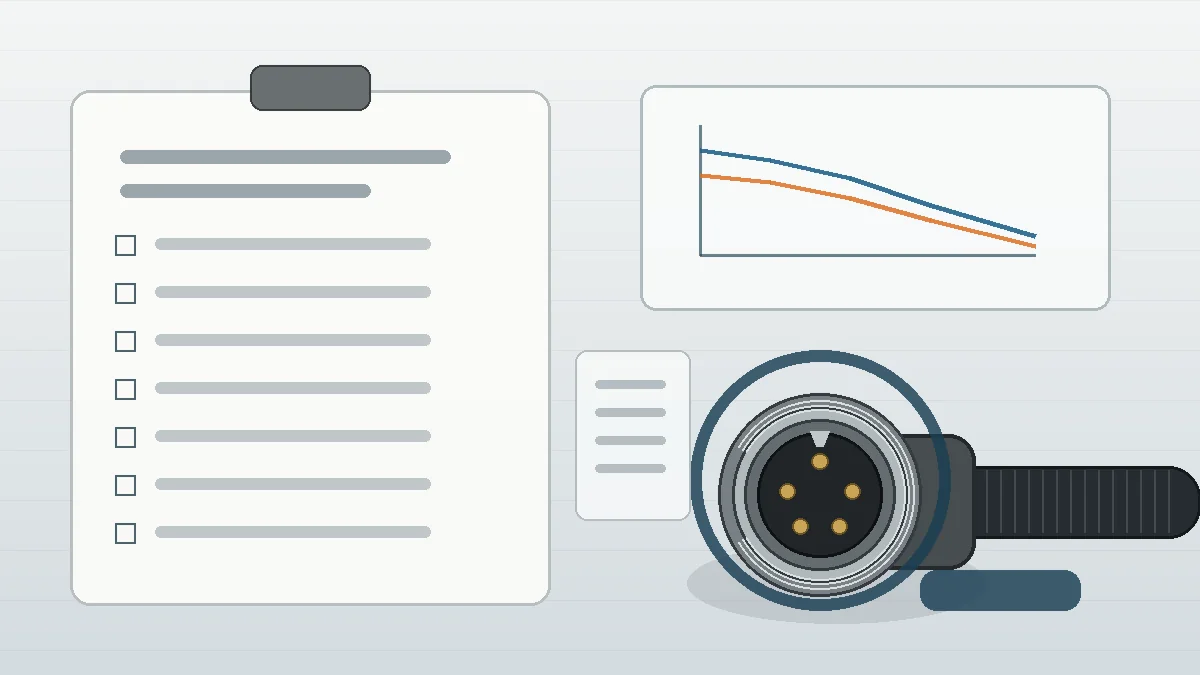
| Approval Item | Status to Record |
|---|---|
| Exact part number or controlled drawing identified | Confirmed / Pending |
| Contact arrangement and coding match the application | Confirmed / Pending |
| Conductor or PCB termination included in the review | Confirmed / Pending |
| Required current listed by circuit | Confirmed / Pending |
| Simultaneously loaded contacts identified | Confirmed / Pending |
| Ambient, enclosure, airflow, and nearby heat sources described | Confirmed / Pending |
| Continuous or intermittent load profile defined | Confirmed / Pending |
| Supplier rating basis or derating evidence received | Confirmed / Pending |
| Any required sample test and acceptance criteria agreed | Confirmed / Pending |
What to Send in an M12 Connector RFQ
A useful RFQ should let engineering and purchasing review the same evidence. Send the controlled drawing or target part, mating information, required current by circuit, conductor or PCB details, ambient and enclosure conditions, simultaneous loading, duty cycle, and the documentation needed for approval. If the project is evaluating a new or modified connector rather than a catalogue part, also identify sample needs and which supplier capabilities must be reviewed.
LinkManu project materials list tooling, stamping, injection molding, and assembly among available manufacturing capabilities. Their applicability depends on connector design and RFQ scope. For projects that need a non-standard connector review, Custom Connector Support can be used to frame the drawing, sample, and documentation discussion. The general connector product families page is a starting point for category review; it should not be read as proof that every M12 configuration is available.
Final Selection Gate
Before the BOM is released, confirm the exact drawing, mating arrangement, conductor or PCB termination, required current, simultaneous loading, operating environment, load cycle, and supplier evidence. If any of those inputs is unknown, keep the current rating as an open engineering question. That is a safer procurement decision than borrowing a number from another M12 part.
Frequently Asked Questions
What is the current rating of an M12 connector?
There is no universal value for every M12 connector. Use the exact part or drawing and confirm the rating against its contact configuration, termination, loading, and operating conditions.
Can I use a current value from another M12 datasheet?
Not without confirming that the connector configuration and rating conditions match. Treat another part’s value as a research lead, not an approval value.
What should I ask the supplier for?
Ask for part-specific rating evidence, the applicable derating guidance, and confirmation for your simultaneous loading, conductor, ambient, enclosure, and duty cycle.
When is sample testing worth considering?
Consider it when the application approaches the supplier’s stated limits, the enclosure changes the thermal condition, or the available documentation does not cover the intended load profile.
Send Your Connector Requirement
Share the drawing or target part, mating details, load profile, environment, and required approval documents. LinkManu can review the RFQ scope and identify which connector, sample, manufacturing, and documentation questions still need confirmation.

Technical content reviewed by LinkManu Engineering Team
Prepared by LinkManu Editorial Team for B2B connector engineers, sourcing teams, and product development projects.