
Wire-to-Board Connector Selection
Wire to Board Connector Housing Selection Guide for Application Fit
This wire to board connector housing selection guide is for projects where the plastic housing, terminal retention, wire routing, and assembly process all affect reliability. The housing is not just a cover around the contacts. It controls how the terminal sits, how the mating pair is keyed, how the wire exits the board, and how much abuse the connection can tolerate after the product leaves the bench.
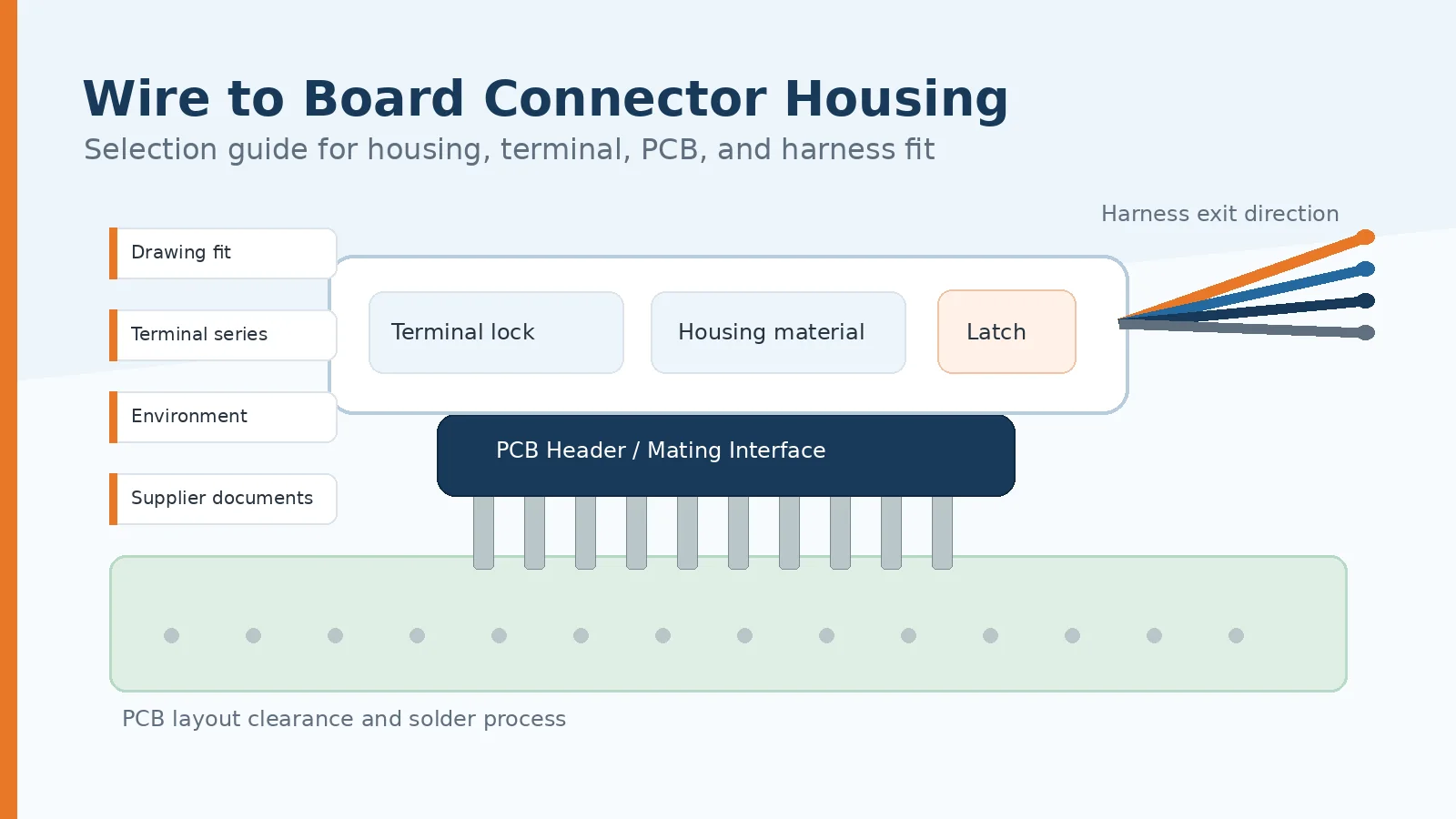
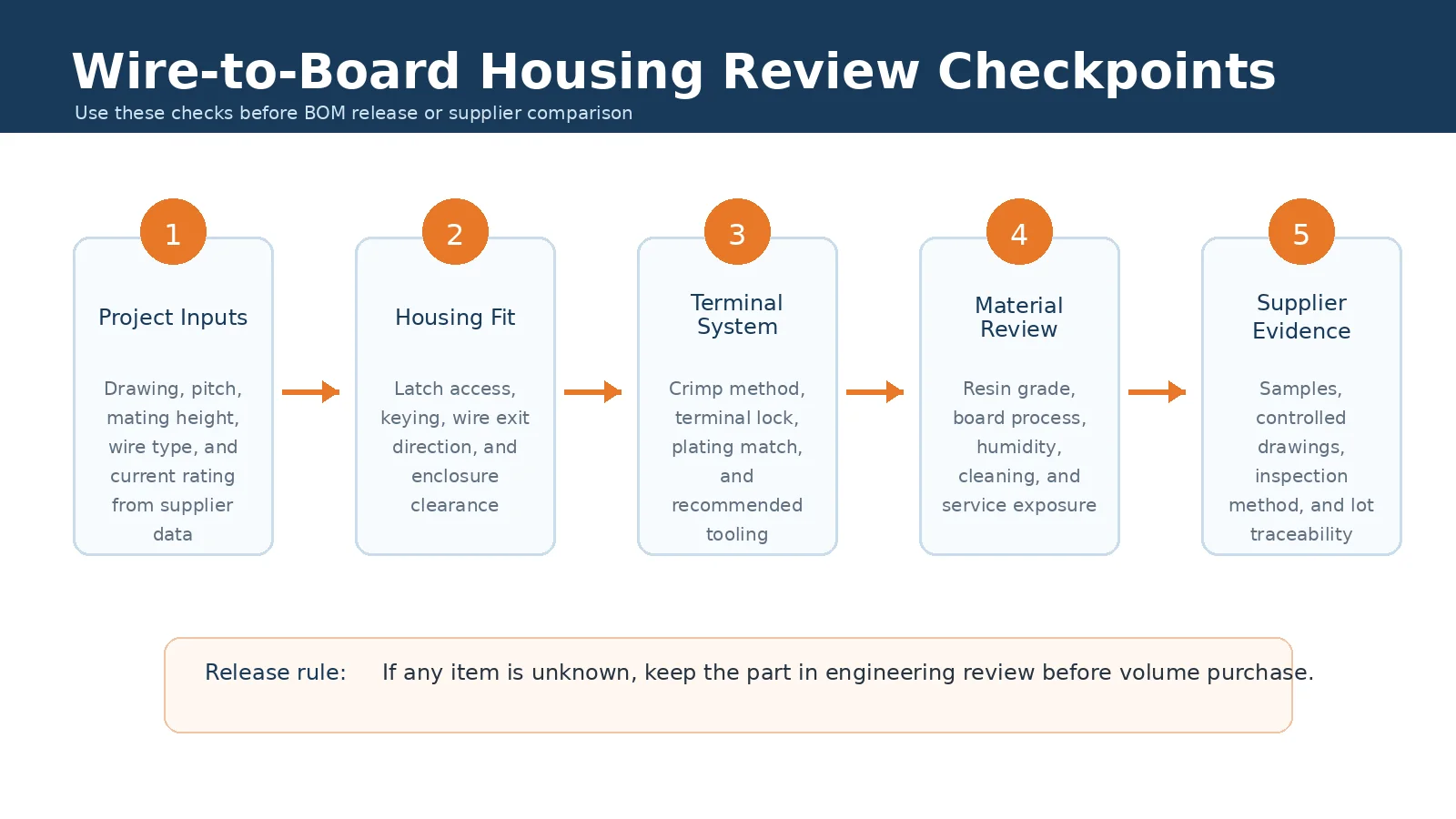
A weak selection usually starts with a reasonable shortcut: the pitch looks close, the circuit count matches, and the sample mates by hand. That is not enough for production. Before approving a housing, engineering and purchasing should confirm the mating height, terminal series, latch style, wire exit direction, resin grade, plating combination, and the expected temperature, vibration, humidity, and cleaning exposure. If any one of those items is unknown, the part should stay in engineering review instead of moving straight into the BOM.
Project rule: do not approve a connector housing from the housing drawing alone. Match it to the terminal drawing, PCB header drawing, crimp specification, harness route, and the supplier documentation you will actually receive with production lots.
Start With the Failure Mode You Cannot Afford
Different projects fail in different ways. A low-vibration indoor controller may mainly need correct keying, stable crimp insertion, and repeatable assembly. A machine exposed to movement or field service needs stronger retention and better strain relief planning. A compact PCB with crowded routing may need a side-entry or low-profile housing, but that choice can create a wire bend problem if the harness exits against a cover or chassis wall.
The practical first step is to name the risk before choosing the housing. If the risk is intermittent signal loss, ask how the terminal is locked and whether wire movement can reach the contact area. If the risk is overheating, confirm the current path, terminal fit, and derating assumptions from the datasheet rather than relying on the plastic body shape. If the risk is assembly error, check polarization, color options, operator access, and whether the latch gives a clear inspection point.
For projects still comparing product families, LinkManu’s Wire-to-Board Connectors for PCB-to-Wire Interfaces page is the right internal starting point. Use it to frame the connector family first; use this article to narrow the housing and sourcing questions after the project constraints are known.
Housing Type Is a Mechanical Decision First
Wire-to-board connector housing types are often described by row count, lock style, mounting direction, and terminal system. Those labels matter, but the engineering decision is more direct: will the housing keep the terminal seated, keep the mating pair aligned, and keep wire force away from the contact interface? If the answer depends on perfect cable dressing by an operator, the selection is probably too fragile for repeat production.
| Housing Choice | What to Check | Selection Risk | Purchasing Question |
|---|---|---|---|
| Friction-retained housing | Insertion feel, terminal seating, unmating force, operator inspection method | Can loosen when wire movement or service handling is higher than expected | Can the supplier provide the matching terminal, crimp guidance, and retention data? |
| Positive latch housing | Latch access, audible or visual confirmation, clearance around the PCB | Latch may be hard to release or inspect if the board is inside a tight enclosure | Can samples be checked in the real enclosure before tooling or volume purchase? |
| Polarized or keyed housing | Key direction, mating header orientation, nearby similar connectors | Wrong orientation can create rework even when the electrical pinout is correct | Are color, keying, or cavity options available for mixed harness assemblies? |
| Higher-retention housing | Primary lock, optional secondary lock, harness strain relief, vibration exposure | Retention feature may solve unmating risk but add assembly steps and inspection needs | Can the supplier support assembly review, samples, and lot traceability? |
The table is not a ranking. A simple housing can be correct when the environment is controlled and the harness is fixed. A stronger lock can be wrong when technicians need frequent access and there is no tool clearance. The useful connector housing selection criteria are the ones tied to your product layout, service model, and assembly process.
Confirm Material and Terminal Compatibility Together
Housing material should be selected against the real operating condition, not against a generic material name. Ask whether the resin grade is suitable for the board process, the enclosure temperature, chemical exposure, humidity, and expected service handling. Do not turn a material family into a blanket approval; additives, glass filling, color, and molding control can change dimensional stability and latch behavior.
Terminal finish also belongs in the same review. One uploaded source warning notes that mixing tin and gold plating in the same connector path can create corrosion risk under the wrong conditions. The safe purchasing action is simple: confirm the terminal finish, mating finish, and supplier recommendation before approving mixed inventory or second-source substitutions. If purchasing changes the terminal while keeping the housing, engineering should recheck the full mated system.
Check the PCB Layout Before the Housing Is Frozen
A housing can be correct on paper and still fail in the product because the board layout gives it no room to work. The connector needs clearance for mating, unlatching, inspection, and wire bend radius. If a cover, heat sink, screw boss, or neighboring component blocks the operator’s hand, the assembly team may pull on wires instead of gripping the housing body. That turns a connector choice into a field reliability problem.
For SMT or through-hole board connectors, match the footprint to the supplier drawing and the solder process. Do not redraw the land pattern from a screenshot or from a visually similar part. A pad mismatch, rotated orientation, or paste issue can make the solder joint carry mechanical stress during mating. The housing review should therefore include the PCB drawing, board thickness assumptions, solder method, and a short assembly trial before release.
Ask Suppliers for Documents That Reduce Risk
A wire to board housing materials discussion is incomplete without manufacturing evidence. The brief for this article allows LinkManu facts such as tooling, stamping, injection molding, assembly capability, and certification references including IATF 16949 and ISO 14001. Those are useful signals, but they do not replace part-level validation. For a real project, ask for the documents that match the exact housing, terminal, and production lot you plan to buy.
Supplier review checklist: request the housing drawing, matching terminal drawing, material declaration, crimp guidance, recommended tooling, sample availability, inspection method, traceability approach, and any test data relevant to your environment. If the project has heat, vibration, humidity, cleaning chemistry, or field service exposure, state those conditions in the RFQ instead of asking for a generic recommendation.
Procurement should also ask what happens when the project needs customization. A housing color change, latch adjustment, cavity blocking, packaging change, or alternate terminal can affect quality control. If the supplier has in-house tooling, stamping, injection molding, and assembly, the review can be more coordinated. Still, the approval should be based on drawings, samples, and documented checks, not only on a capability list.
How Engineering and Purchasing Should Make the Final Call
The final decision should not be “which housing is cheapest.” A better question is: which housing gives engineering enough margin and gives purchasing enough documentation to control risk? If the project is early, shortlist by application environment, circuit count, mating direction, latch need, terminal system, and available samples. If the project is close to production, require drawing confirmation, crimp validation, material review, and supplier traceability before price negotiation.
| Decision Point | Engineering Check | Procurement Check |
|---|---|---|
| Drawing fit | Pitch, mating height, orientation, latch access, PCB footprint | Latest controlled drawing and revision status |
| Terminal system | Terminal lock, crimp quality, wire type, plating compatibility | Matching terminal availability and recommended tooling |
| Application environment | Heat, vibration, humidity, chemical exposure, service handling | Supplier test data or sample plan for those conditions |
| Production readiness | Assembly access, inspection method, harness strain relief | Lot traceability, packaging, lead time, and change-control process |
FAQ
What is the most important factor in housing selection?
Match the housing to the terminal system and real environment first. Price comparison should come after retention, mating direction, material, and assembly checks.
Can I choose a housing by pitch and circuit count only?
No. Pitch and circuit count only narrow the search. You still need mating height, latch style, terminal compatibility, wire exit direction, and supplier drawing confirmation.
When should I ask for custom housing support?
Ask early if the enclosure, cable route, color coding, locking method, or assembly process does not fit a standard housing.
What should I send for a project review?
Send the connector drawing if available, PCB layout constraints, wire details, application environment, expected quantity, and any required test documentation.
Next Step for Housing Review
Before locking the BOM, confirm the drawing, pitch, mating height, terminal series, wire type, latch requirement, current rating from the supplier datasheet, operating environment, required documents, and supplier capability. If those inputs are not fixed yet, share the application constraints first and let engineering narrow the connector housing options before procurement compares price.
Send Your Connector Requirement
Provide your drawing, bill of materials, target application context, or technical specifications. LinkManu can review connector fit, sample needs, documentation requirements, and RFQ readiness for wire-to-board connector housing selection.