
Custom Connector Selection Guide
How to Choose the Right Custom Connector Design Firm for Your Project
Choosing a custom connector design firm usually starts after a catalog part has already created a problem: the footprint is wrong, the mating height is fixed, the cable exit interferes with the housing, or the operating environment asks more from the connector than a standard series can support. At that point, the useful question is not “Can someone make a custom part?” It is “Can this supplier turn our drawing, electrical load, environment, and production plan into a connector that can be built and checked repeatedly?”
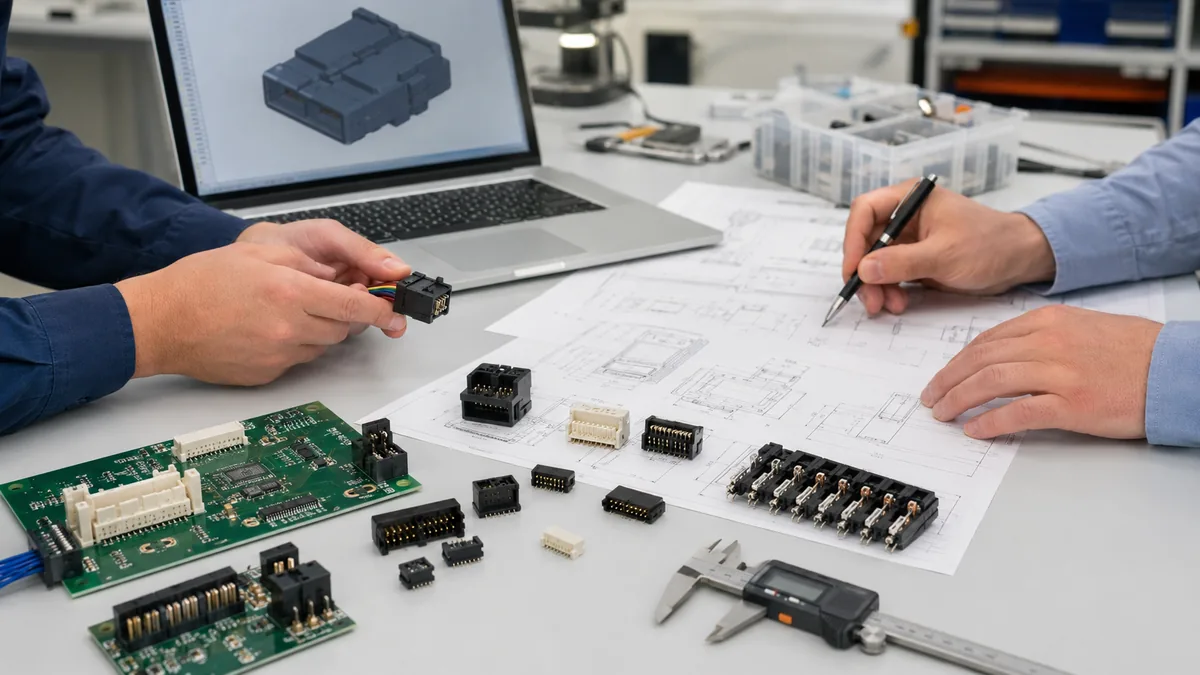
This guide is written for engineering and sourcing teams comparing custom connector design services for electronic hardware, industrial equipment, automotive-related projects, and cable or PCB interconnect assemblies. It does not cover software API custom connectors. For physical connector projects, the checks below help separate a design partner with real manufacturing control from a firm that can only make attractive drawings.
Key takeaway: before you approve a custom connector supplier, confirm five items in writing: drawing ownership, process capability, sample plan, test documentation, and production change control. Missing any one of these can turn a small connector decision into a late-stage project risk.
When a Standard Connector Is No Longer a Good Fit
Standard connectors are useful when the board space, pin count, mating direction, current load, cable route, and environment all sit inside the catalog limits. The trouble starts when one condition is outside that envelope. A housing may force an awkward cable bend. A board-to-board stack may miss the required mating height. A mixed power-and-signal layout may need contact separation that the catalog series cannot offer. In these cases, adapting the surrounding product around the connector can cost more than reviewing a custom design early.
A practical trigger is this: if the mechanical team needs brackets, gaskets, extra retention pieces, or a PCB respin just to make a connector fit, the project should at least compare a custom connector path. The review does not have to commit the team to tooling immediately. It should first test whether the required pitch, mating height, wire exit, contact count, latching method, and operating conditions can be converted into a buildable connector concept.
LinkManu positions its Custom Connectors & Interconnect Solutions work around that early project review: drawing, BOM, sample, or requirement-driven evaluation before final selection. That matters because many connector issues are discovered at the interface between product design and manufacturing, not in the connector model alone.
Start With the Real Requirement, Not the Part Shape
Many custom connector discussions begin with a photo or a rough sketch. That is useful, but it is not enough for engineering judgment. A design firm needs the mating interface, available envelope, board thickness or cable route, target contact count, current and voltage assumptions, mating cycle expectation, and any environmental exposure. If those inputs are missing, any quote is only a placeholder.
| Requirement Area | What to Confirm Before Design Work | Why It Affects Supplier Selection |
|---|---|---|
| Mechanical envelope | Board position, mating height, cable exit, latch direction, keep-out area, and assembly access. | A firm that cannot review tolerance stack-up may make a connector that looks right in CAD but binds during assembly. |
| Electrical load | Continuous current, peak load, voltage assumptions, contact grouping, and temperature-rise expectations. | These inputs drive contact geometry, plating discussion, housing material, and derating review. |
| Signal behavior | Whether the connector carries low-level signals, high-speed data, RF, power, or a hybrid mix. | Mixed layouts need early discussion around spacing, shielding, grounding, and test evidence. |
| Environment | Heat, humidity, vibration, dust, chemical exposure, cable movement, and expected service access. | Material and retention choices should match the worst realistic condition, not the average condition. |
| Production plan | Prototype quantity, pilot run, annual forecast, tooling budget, and inspection documentation needs. | A capable design partner should explain when soft tooling, hard tooling, or modified standard tooling makes sense. |
The procurement risk is quoting too early against an incomplete requirement. If a supplier gives a firm price without asking about mating cycles, operating environment, sample approval, and documentation, treat that quote as a rough commercial signal rather than a design decision.
Check Whether the Firm Controls the Manufacturing Path
A custom connector design firm should be able to explain how the design will move from contact geometry to tooling, molding, stamping, assembly, and inspection. The uploaded project facts support LinkManu-related capability references for tooling, stamping, injection molding, and assembly. Those capabilities are relevant because connector design decisions often need feedback from the shop floor: resin shrinkage, contact forming, cavity balance, plating handling, and assembly fixture access can all change the final design.
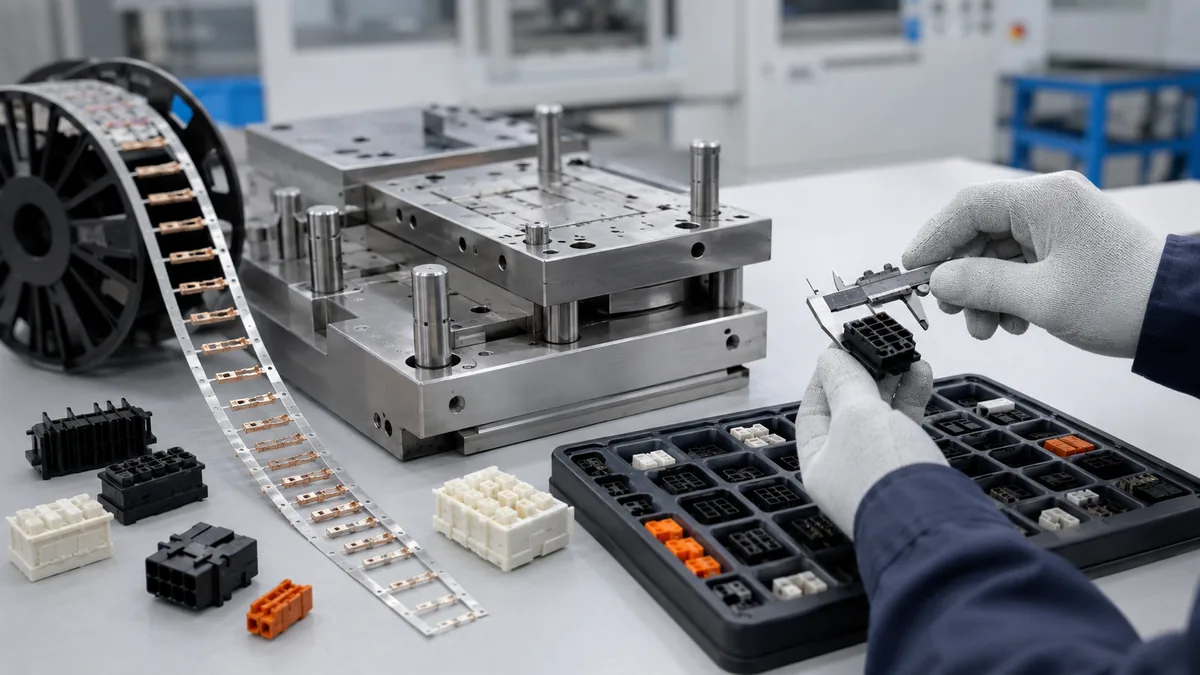
Ask direct questions. Who designs the mold? Who reviews stamped contact spring geometry? Who controls molding process changes? Who performs final assembly? Who owns fixture design for inspection? If the answer moves through too many unnamed subcontractors, the project may still be possible, but the change-control risk is higher.
Manufacturing Checks to Request
- Tooling review: ask how the firm checks parting line, gate position, ejector marks, sink risk, and critical dimensions before mold release.
- Stamping review: confirm how contact geometry, forming direction, base material, and plating plan are reviewed against current load and mating cycle expectations.
- Molding review: ask which housing material options are suitable for the project environment, and request datasheets instead of accepting a generic resin name.
- Assembly review: check whether contact insertion, terminal retention, overmolding, cable termination, or final inspection needs custom fixtures.
- Change control: confirm how engineering changes are documented between prototype, pilot build, and mass production.
This is where design-only firms can struggle. They may create a clean model, but if the molding supplier, stamping supplier, and assembly shop are separate parties with weak feedback loops, small revisions can become slow and expensive. For a connector that must fit a tight product envelope, that delay is not just a schedule issue; it can change the product design path.
Evaluate Engineering Support During Co-Development
A good design partner should challenge the requirement in useful ways. If the drawing asks for a thin wall that may be difficult to mold, the engineer should say so. If the cable exit creates strain near the termination, the review should flag it. If the contact layout mixes power and signal in a way that complicates spacing or test planning, the supplier should ask for the electrical priority before locking the geometry.
That type of feedback is more valuable than a quick “yes.” For sourcing teams, the buying judgment is simple: the supplier that asks precise engineering questions early is often easier to manage later. The supplier that only accepts the drawing may still be fast at quoting, but it may also push unresolved risk into tooling or pilot production.
Engineering check: ask the firm to mark up your drawing with risk comments. Look for notes on mating tolerance, contact retention, cable strain, inspection dimensions, and material assumptions. A plain price quote without those notes is not enough for a custom connector decision.
Review Quality Systems and Documentation Without Overreading Certificates
Quality certificates are useful, but they should not be treated as proof that a specific connector design has already been validated. The uploaded source facts allow references to IATF 16949 and ISO 14001, so these can be part of the supplier review. Still, the practical question is narrower: can the firm provide the documentation your project needs for sample approval, production control, and later traceability?
For engineering and sourcing teams, the useful request is not “Are you certified?” It is “Which documents will we receive at prototype, pilot, and production release?” Depending on the project, that package may include drawing revision history, material datasheets, plating information, dimensional inspection records, sample approval records, and process change notices. If your customer requires additional reports, list them before the quote is finalized.
You can also review LinkManu’s broader process positioning on the Engineering & Quality page, then ask which parts of that process apply to your specific connector. This keeps the discussion tied to evidence instead of general quality language.
Documents Worth Asking For
- Current certificate copies if your project requires IATF 16949, ISO 14001, or customer-specific supplier approval.
- Design drawing with revision control and controlled critical dimensions.
- Material datasheets for housing resin, contact base metal, plating, seal material, or cable components.
- First sample inspection records covering dimensions that affect mating, retention, and assembly fit.
- Test plan or validation matrix that lists what will be checked, who checks it, and when the results are reviewed.
- Production traceability plan for material lots, tooling revisions, and inspection results.
Discuss Electrical, Mechanical, and Environmental Limits Early
The weakest connector decisions often come from treating current rating, voltage, pitch, and material as catalog fields instead of project conditions. A connector that works in a low-vibration indoor assembly may be the wrong choice when the cable moves, the housing traps heat, or the mating force changes after repeated service. The design firm should ask where the connector sits in the system and how it will be handled during assembly and maintenance.
| Design Topic | Question to Ask the Firm | Decision Risk if Skipped |
|---|---|---|
| Contact design | How will contact force, retention, plating, and wear be reviewed against the expected mating cycle? | The connector may pass a quick fit check but show unstable resistance after repeated mating or vibration. |
| Housing material | Which resin options fit the assembly process, operating environment, and dimensional stability needs? | A material chosen only for cost may create warpage, heat, or chemical exposure issues later. |
| Power and signal mix | How will power contacts, signal contacts, shields, grounds, and spacing be arranged and reviewed? | Late electrical concerns can force a layout change after mechanical tooling has already started. |
| Cable or PCB interface | What strain relief, soldering, press-fit, crimp, or board retention method is planned? | The connector may fit the product but fail during assembly handling or service movement. |
| Validation | Which checks are required for the intended environment, and which results will be included in the approval package? | The team may approve samples without evidence for the conditions that matter most. |
Do not insert unsupported target numbers just because a competitor page or one-off web source mentions them. For a real RFQ, the safer path is to state your project requirements and ask the supplier to confirm the applicable standard, test method, and report format. That keeps the article and the project grounded in evidence.
Use Samples to Test More Than Basic Fit
Prototype samples are not only for checking whether two parts mate. They should help the team evaluate assembly access, cable bend, latch feel, insertion and extraction behavior, board clearance, and inspection access. If the sample only proves that the connector exists, it has not done enough work.
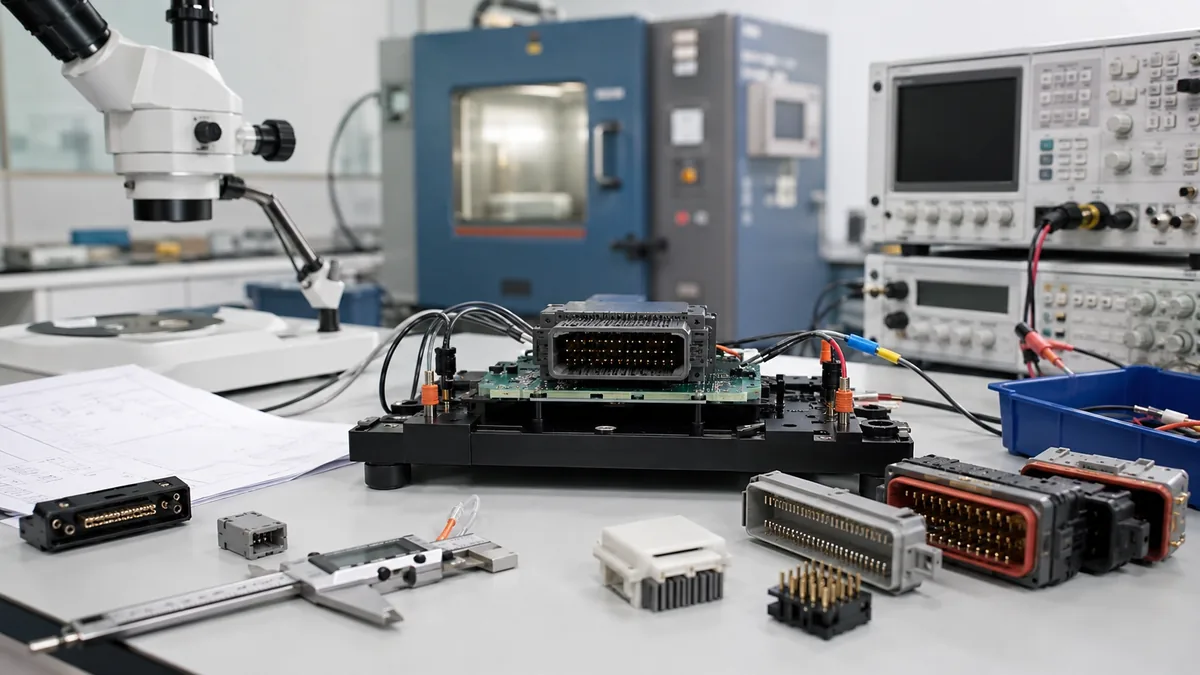
Before sample approval, agree on what the sample is meant to prove. A 3D-printed housing may validate space claim, but it may not prove final resin behavior. A soft-tooled part may support early assembly review, but it may not represent full production cavity consistency. A stamped contact sample may help evaluate retention and handling, but plating and final process conditions still need confirmation.
For buyers, this creates a clear milestone question: what decision are we making after this sample? If the answer is “release hard tooling,” the evidence bar should be higher than if the answer is “continue concept review.”
Compare the Commercial Model Behind the Quote
Custom connector quotes can look very different because suppliers may include different assumptions. One quote may include design review, prototype support, tooling, sample testing, and pilot documentation. Another may list only piece price and leave engineering changes open. A lower unit price can become expensive if every revision, test report, or fixture adjustment becomes a new negotiation.
Ask the firm to separate non-recurring engineering cost, tooling cost, sample cost, expected pilot quantity, production MOQ, lead time assumptions, and revision policy. If the connector depends on special materials, plating, or a unique process, ask which items are single-source and what happens if a material changes. These are procurement questions, but they directly affect engineering continuity.
Procurement check: do not compare quotes only by piece price. Compare what each quote includes: design review, tooling scope, sample approval, documentation, change handling, and production support.
Red Flags When Selecting a Connector Design Partner
- No drawing review: the firm quotes immediately but does not ask about mating interface, load, environment, or assembly process.
- Vague manufacturing ownership: the supplier cannot explain who controls tooling, stamping, molding, assembly, and inspection.
- Unsupported performance claims: the firm promises ratings, compatibility, or reliability without a test plan or source document.
- Weak revision control: sample changes are discussed by email but not reflected in a controlled drawing or change record.
- Unclear IP handling: tooling ownership, drawing access, and confidentiality terms are not documented before development starts.
- No pilot plan: the jump from prototype to mass production is not broken into sample approval, pilot run, and production release.
Practical Next Step Before You Send an RFQ
Before contacting a custom connector design firm, collect the files and assumptions that will let the supplier give an engineering response instead of a loose estimate. At minimum, prepare the drawing or sketch, mating connector information if available, PCB or cable layout, required pitch and mating height, current and voltage assumptions, operating environment, target sample quantity, annual forecast, and documentation requirements.
If some details are not final, mark them as open items. A good design partner can still review the project, but it should separate confirmed requirements from assumptions. That discipline protects both sides: engineering can see which decisions are still flexible, and procurement can avoid treating an early concept quote as a production-ready offer.
If your team is still comparing standard and custom paths, review the relevant product families on LinkManu Products and then send the project context through Contact LinkManu. The most useful first message includes the drawing, target application, connector location in the assembly, and the problem the standard part could not solve.
FAQ
When should I contact a custom connector design firm?
Contact one when a standard connector forces layout compromises, creates assembly workarounds, or cannot match your electrical, mechanical, or environmental requirements.
What files should I send for the first review?
Send a drawing or sketch, PCB or cable layout, mating interface details, target current and voltage, environment, sample quantity, forecast, and documentation needs.
Is a custom connector always better than a standard connector?
No. If a standard connector meets fit, performance, sourcing, and lifecycle needs, it may be the lower-risk choice. Custom design makes sense when the standard option creates system-level risk.
What should procurement compare besides unit price?
Compare tooling scope, sample plan, included documentation, revision policy, MOQ, lead time assumptions, and who owns manufacturing control.
How can I reduce risk before tooling starts?
Ask for drawing risk comments, material assumptions, sample approval criteria, inspection dimensions, and a written change-control path before releasing tooling.
Send Your Connector Requirement
Share your drawing, BOM, sample photo, target application, or open engineering questions. LinkManu can review connector fit, manufacturing path, documentation needs, and RFQ readiness before final selection.

Technical content reviewed by LinkManu Engineering Team
Prepared by LinkManu Editorial Team for B2B connector engineers, sourcing teams, and product development projects. Updated 2026.