
Automotive Connector Engineering
What Is a Deutsch Connector? An Automotive Buyer Review Checklist
What is a Deutsch connector? It is a sealed electrical connector format commonly used in vehicles and equipment exposed to vibration, moisture, dust, and temperature changes. The name covers several connector families, so it should begin the selection process—not replace a specification. The correct configuration still depends on the circuit, wire, environment, mating arrangement, and project validation plan.
For engineering and procurement teams, the practical task is to turn a request for a “Deutsch-style connector” into a sourcing package that can be checked against drawings, samples, and production records.
Why a Visual Match Is Not Enough
Two housings may look interchangeable while differing in contact retention, seal fit, material, keying, or production consistency. A desk review may miss those differences. They can appear after vibration, thermal cycling, fluid exposure, repeated mating, or assembly-line handling.
- Weak contact retention can produce intermittent circuits.
- An incorrectly matched wire seal can create a moisture path.
- Unclear polarization or keying can lead to mis-mating.
- Housing material may be unsuitable for the project’s chemicals or temperature profile.
- Production can stop when drawings, samples, and inspection records describe different configurations.
Buyer check: Do not approve a part from appearance or unit price alone. Rework, diagnostics, revalidation, and field service can outweigh a small purchasing saving.
Use the Connector Family as an Initial Filter
DT, DTM, DTP, and HDP are common family names, but the family alone does not confirm electrical suitability or environmental performance. Buyers should request controlled documentation for the exact housing, contact, seal, and accessory combination under review.
| Review area | What the buyer should confirm |
|---|---|
| Circuit layout | Position count, pinout, unused cavities, orientation, and keying |
| Conductors | Wire size, insulation diameter, contact compatibility, and crimp method |
| Electrical load | Project current, voltage, temperature rise, and derating requirements |
| Environment | Temperature profile, vibration, moisture, dust, fluids, and UV exposure |
| Assembly | Tooling, insertion checks, secondary locks, cavity plugs, and service procedure |
| Validation | Applicable project tests, acceptance criteria, and evidence required for approval |
Do not transfer a rating from another series, contact, wire size, or test condition. Compare the current drawing and datasheet for the proposed configuration with the actual project specification.
Buyer’s Engineering Review Checklist
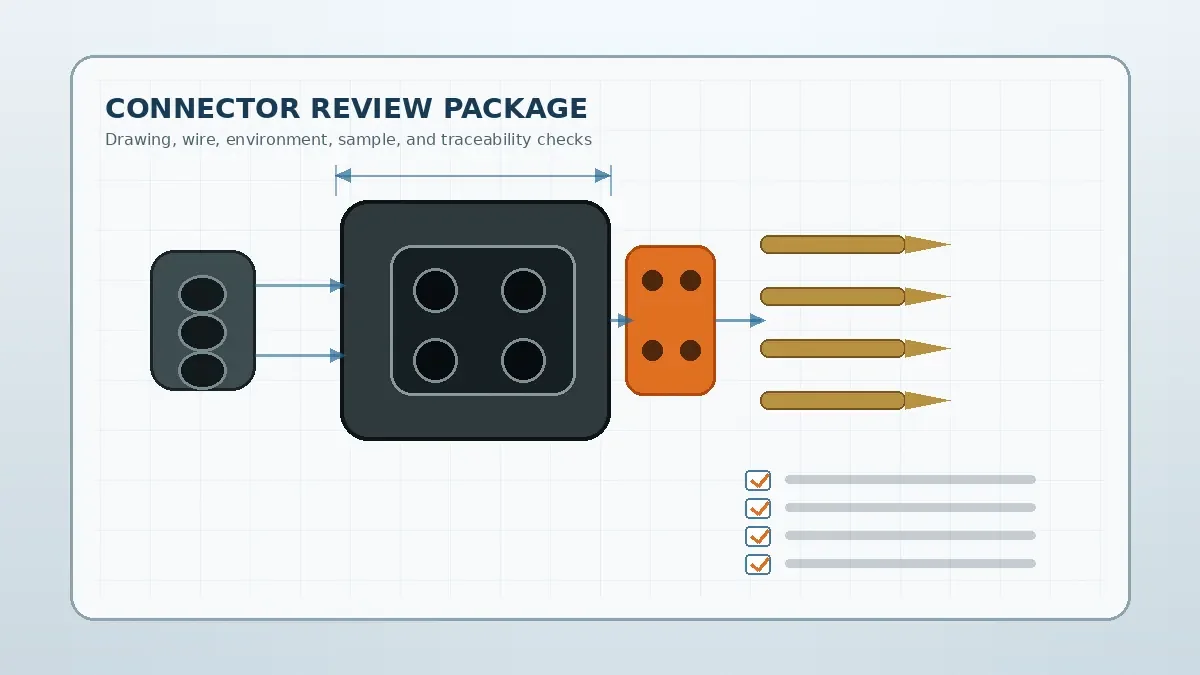
1. Lock the Mechanical Definition
Identify the exact position count, connector orientation, mating interface, keying, mounting features, and available space. The drawing should distinguish plug and receptacle views and identify the contact side.
- Are every cavity and circuit assignment shown?
- Are backshells, clips, seals, plugs, and secondary locks included in the BOM?
- Is there room for mating, unmating, service access, and harness bend?
2. Match the Wire and Contact System
Housing selection cannot be separated from the terminal and wire. Confirm conductor and insulation dimensions, contact type, crimp tooling, and inspection method. A sample that merely mates is not sufficient; review crimp quality, contact insertion, secondary locking, and cavity sealing as one assembly process.
3. Define the Real Operating Environment
Replace terms such as “waterproof” or “automotive grade” with project conditions. State the mounting zone, temperature profile, vibration and shock exposure, fluids, pressure washing, temporary immersion, dust, UV exposure, and expected service handling. Each requirement should map to a drawing note, material record, test report, or planned validation step.
4. Review Materials and Traceability
Request the material and plating information required by the project. Do not assume that one material specification suits every vehicle zone. For production control, confirm lot identification, dimensional inspection of critical features, change notification, handling of nonconforming parts, and sample-to-production configuration control.
5. Control Compatibility Claims
“Equivalent,” “replacement,” and “compatible” are engineering claims. Compare controlled drawings, the mating interface, materials, contact system, test requirements, and application constraints. Until compatibility is supported by current evidence and a production-intent sample, describe the part as a candidate for evaluation—not an approved replacement.
Review the Supplier from RFQ to Production Sample
A useful RFQ includes the drawing, BOM, annual quantity, application, environment, validation requirements, and document expectations. This gives the supplier a chance to identify missing information before tooling or sampling starts.
LinkManu’s uploaded company information supports project-dependent capabilities in terminal stamping, housing molding, tooling, connector assembly, and engineering review. The exact manufacturing and analysis scope should be agreed during RFQ review rather than assumed for every order. Related information is available on Automotive Electronics Connector Solutions and Engineering & Quality.
Management-system certificates can support supplier screening, but a certificate name does not approve a connector. Request current copies, verify scope and validity, and connect the relevant controls to the product, facility, and process being reviewed.
Pre-Production Approval Steps
- Freeze the controlled drawing and BOM.
- Confirm the housing, contact, seal, and accessory combination.
- Inspect production-intent samples rather than display samples.
- Validate mating, assembly, and environmental requirements.
- Record deviations, responsibilities, and approvals.
- Confirm packaging, labeling, lot traceability, and change control.
The decision should not end with a family name. Approval requires evidence that the complete connector system fits the project’s electrical, mechanical, environmental, manufacturing, and documentation requirements.
Frequently Asked Questions
How do I identify the correct Deutsch connector family?
Start with circuit count, wire dimensions, load, available space, and environmental exposure. Shortlist a family, then verify the exact configuration against current controlled documentation.
Are Deutsch connectors waterproof?
Do not rely on a generic waterproof claim. Confirm the required ingress condition, exact part configuration, wire seals, assembly process, and project-specific test evidence.
Can a Deutsch-style connector replace an existing part?
Only after dimensional, electrical, material, environmental, and mating compatibility are demonstrated. A visual match is not enough.
What should be included with a sample request?
Include the drawing, pinout, wire information, mating part, accessories, environment, validation plan, and required inspection or traceability documents.
Send Your Connector Requirement
Share the drawing, BOM, target application, and technical requirements. LinkManu can review fit questions, sample options, documentation needs, and RFQ readiness before final selection.

Technical content reviewed by LinkManu Engineering Team
Prepared by LinkManu Editorial Team for B2B connector engineers, sourcing teams, and product development projects.